Google Ads vs Local SEO for Service Businesses: Where Should You Spend Your Money?
Table of Contents
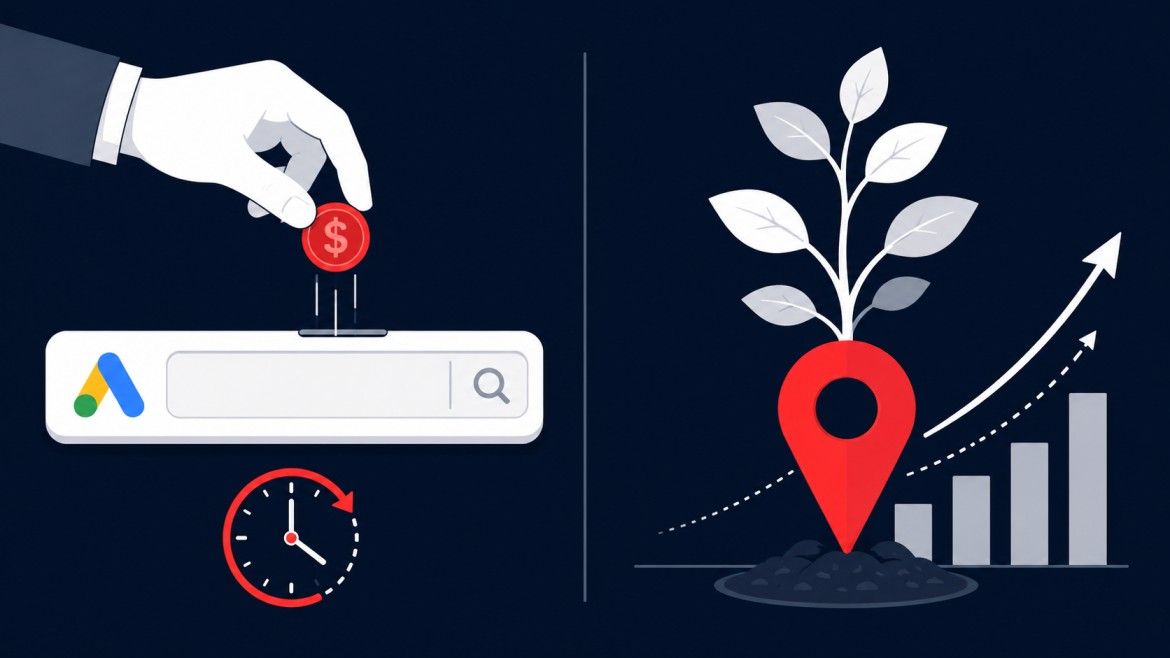
You have a limited marketing budget. You need more phone calls, more booked jobs, and more revenue. So you ask the question every local service business owner eventually asks:
Should I spend money on Google Ads or invest in local SEO?
It is a fair question. Both can get your business in front of people who are actively searching for your services. Both can generate real leads. But they work very differently — and choosing the wrong one at the wrong time can burn through your budget fast.
In this guide, we break down Google Ads and local SEO side by side. We will show you real cost data, compare ROI over time, and help you decide exactly where your marketing dollars should go based on your specific situation.
No vague advice. Just numbers, facts, and a clear strategy you can act on today.
How Does It Work for Service Businesses?
Google Ads is a pay-per-click (PPC) advertising platform. You bid on keywords related to your services, and your ad appears at the top of Google search results. Every time someone clicks your ad, you pay.
For service businesses, this usually means bidding on keywords like "plumber near me," "emergency HVAC repair," or "roof repair Austin TX." Your ad shows up above the organic results and the Google Map Pack, giving you instant visibility.
There are two main types of Google Ads that local service businesses use:
Google Search Ads — These are the text-based ads that appear at the top and bottom of search results. You pay per click, and costs vary based on your industry and location.
Google Local Services Ads (LSAs) — These appear at the very top of search results with a "Google Guaranteed" badge. You pay per lead (phone call or message) instead of per click. Google verifies your business through background checks and license verification before you can run LSAs. According to Reactll's 2026 analysis, LSA leads typically cost between $25–$75 per lead depending on the trade and market.
The big advantage of Google Ads? Speed. You can set up a campaign in the morning and start getting calls by the afternoon. The big disadvantage? The moment you stop paying, the calls stop too.
What Is Local SEO and How Does It Work?
Local SEO is the process of optimizing your online presence so your business appears in organic (unpaid) search results when people search for services in your area. This includes showing up in Google's Map Pack, in organic search results below the ads, and increasingly in AI-powered search platforms.
Local SEO involves several key activities:
- Optimizing your Google Business Profile with accurate information, categories, photos, and posts
- Building consistent citations (business listings) across directories like Yelp, BBB, and Yellow Pages
- Getting and managing customer reviews on Google
- Creating location-specific pages on your website
- Building local backlinks from relevant websites in your area
- Making sure your website is fast, mobile-friendly, and properly optimized
The big advantage of local SEO? Once you rank, you get leads without paying per click. The traffic compounds over time. The big disadvantage? It takes time — usually 3 to 6 months before you see meaningful results.
For a full breakdown of everything involved, check out our local SEO checklist for small businesses.
Google Ads vs Local SEO: Side-by-Side Comparison
Here is a direct comparison of the two strategies across the factors that matter most to service businesses:
| Factor | Google Ads | Local SEO |
|---|---|---|
| Time to results | Immediate (same day) | 3-6 months for meaningful rankings |
| Cost structure | Pay per click or per lead, ongoing | Monthly investment, compounds over time |
| What happens when you stop | Traffic stops immediately | Rankings persist for months |
| Average click-through rate | 6.66% for search ads (WordStream, 2025) | 39.8% for #1 organic result (First Page Sage, 2025) |
| Trust factor | Labeled as "Sponsored" | Perceived as earned, more trusted |
| Control over messaging | Full control of ad copy | Limited to meta descriptions and titles |
| Scalability | Scale instantly with more budget | Scale requires more content, links, and time |
| Visibility in AI search | Not visible in AI platforms | Content can be cited by ChatGPT, Perplexity, Gemini |
| Best for | Immediate leads, new markets, seasonal spikes | Long-term growth, cost reduction, brand authority |
The most important row in this table is what happens when you stop. With Google Ads, your pipeline goes to zero overnight. With local SEO, your rankings and traffic continue generating leads even if you pause your investment for a few months. This is why so many service businesses are shifting toward organic strategies — as we explain in our guide on why your competitor ranks above you on Google Maps.
The Real Cost of Google Ads for Service Businesses (2026 Data)
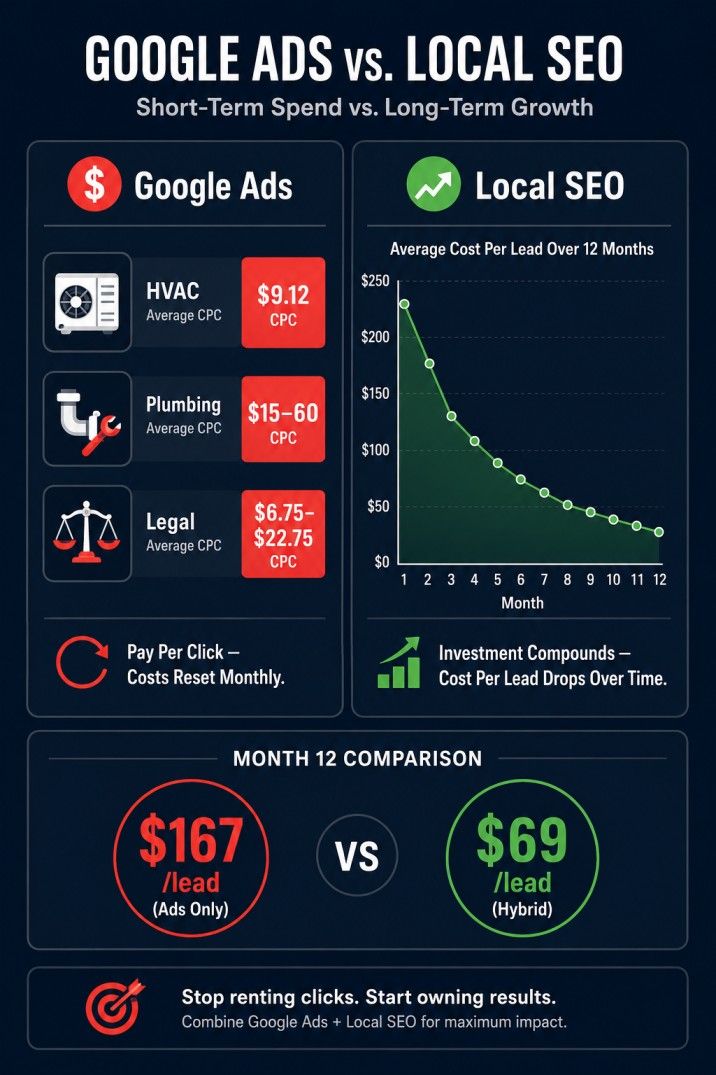
Let us talk real numbers. The cost of Google Ads varies wildly depending on your industry, your location, and how competitive your market is.
According to Backlinko's analysis of over one million keywords from Semrush's U.S. database, the average cost per click for Google Search ads in 2025 was $8.34, with a median CPC of $4.52. Legal had the highest average CPC at $22.75, while ecommerce had the lowest at just $0.82 per click.
Here are actual cost-per-click (CPC) and cost-per-lead benchmarks for common service industries based on 2025-2026 data:
| Industry | Average CPC (Search Ads) | Cost Per Lead (Non-Branded) | Source |
|---|---|---|---|
| HVAC | $9.12 | $149 | SearchLight Digital, Jan 2026 |
| Plumbing | $15–$60 (varies by city) | $167 | SearchLight Digital, Jan 2026 |
| Legal Services | $6.75–$22.75 avg (up to $137+ for PI) | $200–$400+ | Backlinko/Semrush, 2025; WebFX, 2026 |
| Home Services (general) | $6.40 | $80–$150 | Get-Ryze, Apr 2026 |
| Roofing | $15–$45 | $150–$250 | Industry benchmarks, 2025-2026 |
To put this in perspective: if you are an HVAC company spending $3,000 per month on non-branded Google Ads, you can expect roughly 20 leads per month at $149 per lead. According to SearchLight Digital's January 2026 benchmark, HVAC leads have a 41.5% book rate and a $2,208 average ticket, producing a 2.72x closed ROAS. That means about 8 booked jobs generating approximately $17,600 in revenue — a solid return, but one that disappears the moment you pause spending.
And these costs keep rising. WebFX reports that geographic targeting creates massive CPC variations for identical services. For example, plumbers in Denver pay $59.81 per click — 137% above the national average of $25.27 — while plumbers in Birmingham pay only $15.53, which is 39% below average. That is a nearly 4x cost difference for the exact same keyword.
If your business information is wrong or inconsistent across the web, you will waste even more ad spend because Google may show your ads for irrelevant searches or penalize your Quality Score.
The Real Cost of Local SEO for Service Businesses
Local SEO costs look very different from Google Ads because you are building an asset, not renting visibility.
Here is what local SEO typically costs for service businesses in 2026:
| Investment Type | Monthly Cost Range | What You Get |
|---|---|---|
| DIY / Self-managed | $0–$200 | Your time + basic tools (Google Business Profile optimization, manual citations) |
| Freelancer / Consultant | $500–$1,500 | GBP optimization, citations, basic on-page SEO |
| Agency (standard) | $1,500–$3,000 | Full local SEO: GBP, citations, reviews, content, backlinks |
| Agency (competitive market) | $3,000–$5,000+ | Aggressive strategy for high-competition markets |
The key difference is what these costs produce over time.
In month 1, your local SEO investment may generate zero leads. By month 3, you might start seeing some movement. By month 6, you could be in the Map Pack generating 20-30+ leads per month. And by month 12, those leads keep coming at near-zero marginal cost — because your rankings, reviews, and content assets keep working for you.
The math over 12 months:
Scenario: An HVAC company choosing between $3,000/month on Google Ads vs $2,000/month on local SEO.
- Google Ads (12 months): $36,000 spent → ~240 leads → leads stop when budget stops
- Local SEO (12 months): $24,000 spent → slow start, then accelerating leads → leads continue after month 12 with reduced or zero spend
By month 18, the local SEO path often delivers a lower cost per lead than Google Ads ever could — because the upfront investment has been made and the recurring cost drops while the leads keep flowing.
According to Reactll's analysis, a 2025 ServiceTitan study found that home service companies combining both channels saw 40% lower overall cost per acquisition than those using either alone. This is why many business owners describe local SEO as an investment and Google Ads as an expense.
Click-Through Rates: Organic vs Paid in Local Search
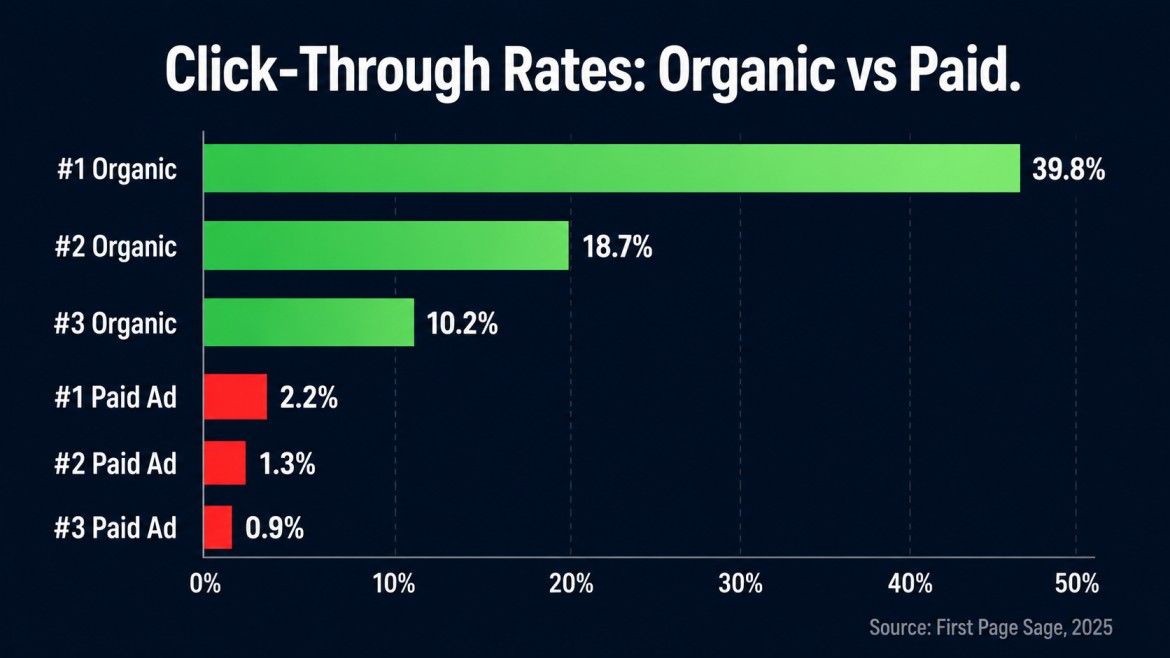
One of the most overlooked differences between Google Ads and local SEO is how many people actually click on each type of result.
According to First Page Sage's 2025 CTR study, the click-through rate differences are dramatic:
| Search Result Position | Click-Through Rate | Source |
|---|---|---|
| #1 Organic Result | 39.8% | First Page Sage, 2025 |
| #2 Organic Result | 18.7% | First Page Sage, 2025 |
| #3 Organic Result | 10.2% | First Page Sage, 2025 |
| Top 3 Organic Combined | 68.7% | First Page Sage, 2025 |
| #1 Paid Ad | 2.2% | First Page Sage, 2025 |
| #2 Paid Ad | 1.3% | First Page Sage, 2025 |
| #3 Paid Ad | 0.9% | First Page Sage, 2025 |
| Average Paid Ad CTR (all industries) | 6.66% | WordStream, 2025 |
The top organic result gets almost 18 times more clicks than the top paid ad. The top 3 organic results together capture over two-thirds of all clicks on the page.
This data is backed by other research too. According to Sender's 2026 CTR statistics roundup, the top organic result at 39.8% CTR dwarfs any paid placement, which is why SEO continues to matter even as Google adds more ad placements to search results.
Additionally, Digital Silk's analysis of organic vs paid search notes that 75% of users never go past the first page of results. For local service businesses, this means being in the top 3 organic spots — especially the Map Pack — is where the real lead volume lives.
This matters because clicks translate directly into calls, form submissions, and booked jobs. If 1,000 people search for "plumber near me" in your city each month, ranking #1 organically could send 398 of them to your listing. The top ad position would send about 22.
When Google Ads Makes More Sense
Google Ads is not the enemy. It is a powerful tool when used in the right situations. Here are the scenarios where Google Ads is the better choice:
1. You need leads right now. If your phone is not ringing and your schedule has gaps next week, Google Ads can fill them. SEO cannot deliver overnight results.
2. You just launched a new business. A brand new business with no online presence, no reviews, and no content will struggle to rank organically for months. Ads bridge that gap while you build your Google Business Profile.
3. You are expanding into a new service area. If you just started serving a new city, ads can generate leads there while you build your local SEO presence with city-specific pages and local citations.
4. Seasonal demand spikes. HVAC companies in July, roofing companies after a major storm — these are moments where ads let you capture demand you would miss waiting for SEO.
5. You are testing a new service offering. Not sure if "ductless mini-split installation" will generate leads in your market? Run ads for a month and find out before investing in SEO content.
6. Your competitors dominate the organic results. If the top 3 organic spots are locked by established competitors with years of SEO momentum, ads let you appear above all of them while you build your own organic presence. To understand what gives those competitors their edge, read our breakdown of why your competitor ranks above you on Google Maps.
When Local SEO Makes More Sense
Local SEO is the better long-term investment in most situations. Here is when it clearly wins:
1. You want to reduce your cost per lead over time. Every month your SEO improves, your effective cost per lead drops. After 12-18 months, organic leads often cost a fraction of what paid leads cost.
2. You want leads that do not depend on your ad budget. Ranking in the Map Pack means calls come in whether you are spending on ads or not. That is real business stability.
3. You want to build trust and authority. According to BrightLocal's Consumer Search Behavior Report (2025), 45% of consumers default to Google for local searches, with 15% going directly to Google Maps. They scroll past ads and click on organic results because they trust them more.
4. You want visibility in AI search platforms. This is the big one for 2026. BrightLocal's Local Consumer Review Survey (2026) found that 45% of consumers now use ChatGPT or other generative AI tools for local business recommendations — up from just 6% the year before. Google Ads do not appear in AI search results. Only organic content — your website, your blog posts, your citations — can get cited by AI platforms.
5. You operate in a market with very high CPCs. If you are a lawyer paying $50-100+ per click (Get-Ryze, 2026), or a plumber in a competitive metro paying $40-60 per click (WebFX data), the math on ads gets brutal fast. Local SEO delivers the same leads at a fraction of the cost once you rank.
6. You plan to be in business for more than a year. If you are thinking long-term, every dollar spent on local SEO compounds. Every dollar spent on ads is gone the moment the click happens.
Want to see exactly where your business stands in local search right now? Our Google Business Profile optimization service is a great place to start. Or if you are not sure whether your GBP is even visible, check our guide on why your GBP might not be showing up.
The Hybrid Strategy: How Smart Service Businesses Use Both
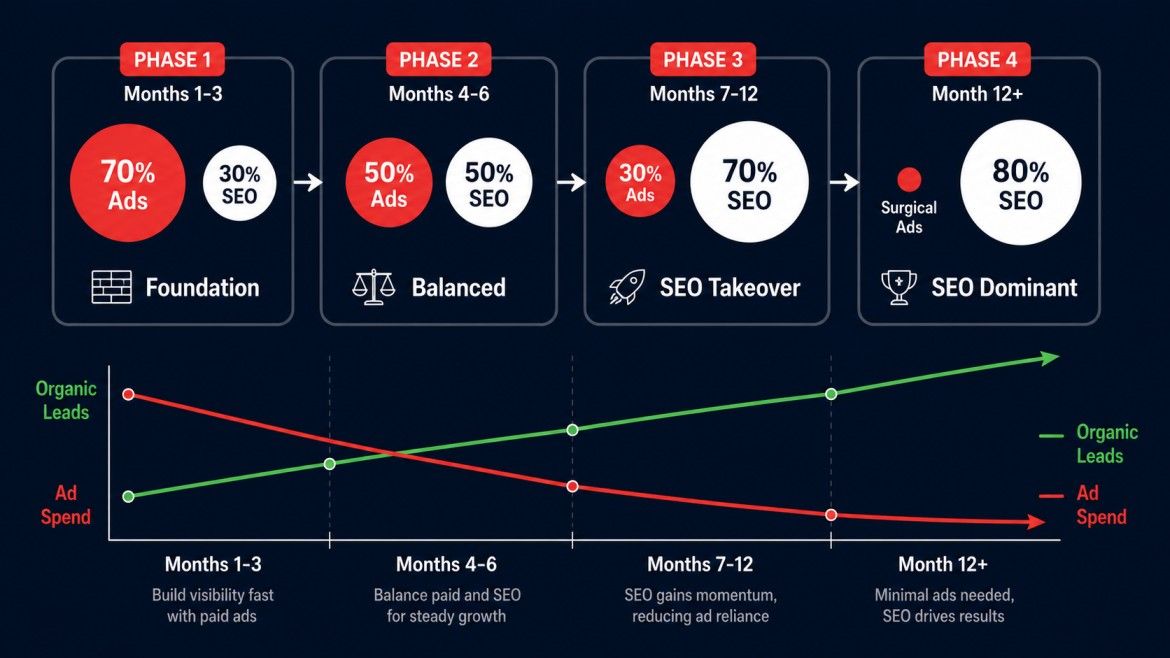
The best-performing local service businesses do not choose one or the other. They use both — strategically.
According to Reactll's 2026 analysis, a ServiceTitan study found that home service companies combining both channels saw 40% lower overall cost per acquisition than those using either alone.
Here is the phased approach we recommend:
Phase 1 (Months 1–3): Ads heavy, SEO foundation
- Allocate 70% of budget to Google Ads for immediate lead flow
- Allocate 30% to SEO foundation — Google Business Profile optimization, citation building, website fixes
- Start collecting Google reviews from every completed job using a review management system
- Create service pages and location pages on your website
Phase 2 (Months 4–6): Balanced investment
- Shift to 50/50 split between ads and SEO
- SEO starts generating some organic leads
- Use ad data to identify highest-converting keywords — then create SEO content targeting those same keywords
- Build local backlinks and publish blog content using proven link building strategies
Phase 3 (Months 7–12): SEO heavy, ads strategic
- Shift to 30% ads, 70% SEO
- Organic rankings now generating consistent leads
- Use ads only for high-urgency keywords, new service areas, or seasonal spikes
- Reinvest ad savings into content and link building
Phase 4 (Month 12+): SEO dominant, ads surgical
- SEO handles 70-80% of your lead generation
- Google Ads used only for targeted campaigns — new areas, new services, competitive keywords
- Total cost per lead drops significantly
- Marketing becomes an asset, not just an expense
This is the approach that consistently delivers the best results for service businesses. It gives you the best of both worlds: immediate leads from ads and compounding returns from SEO.
Real Example: A Plumbing Company's 12-Month Journey
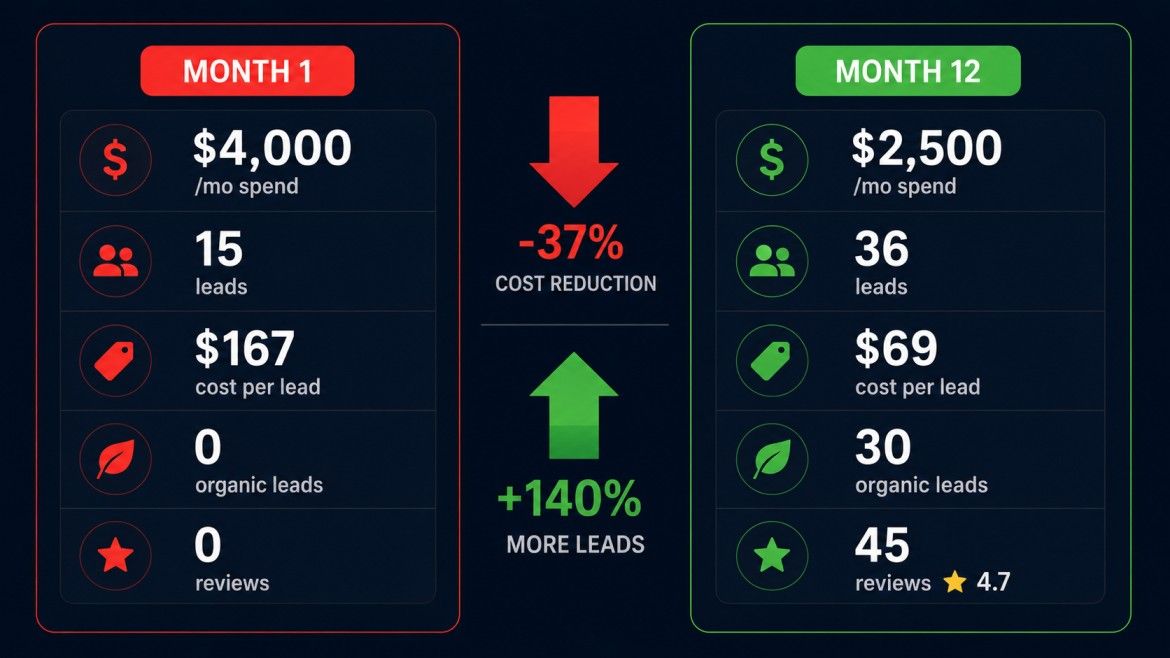
Here is how one plumbing company in Austin, TX, combined Google Ads and local SEO over 12 months.
Starting point: New business, zero online presence, zero reviews, no website ranking for any keywords. Needed calls immediately. Their Google Business Profile was not showing up at all.
Month 1–3 (Ads heavy):
- Google Ads budget: $2,500/month
- Local SEO investment: $1,500/month (GBP optimization, citations, website cleanup)
- Google Ads generated: ~15 leads/month at $167 per lead (in line with SearchLight Digital's plumbing benchmark)
- Organic leads: 0
- Total monthly investment: $4,000
Month 4–6 (Balanced):
- Google Ads budget reduced to: $2,000/month
- Local SEO continued at: $1,500/month
- Google Ads generated: ~12 leads/month
- Organic leads started appearing: ~8/month
- Total monthly investment: $3,500
- Google reviews grew from 0 to 22
Month 7–12 (SEO taking over):
- Google Ads budget reduced to: $1,000/month
- Local SEO continued at: $1,500/month
- Google Ads generated: ~6 leads/month
- Organic leads climbed to: ~30/month
- Total monthly investment: $2,500
- Google reviews reached 45, average rating 4.7
The result after 12 months:
- Total spent on Google Ads: $22,500
- Total spent on local SEO: $18,000
- Total investment: $40,500
- Month 12 leads: 36 (30 organic + 6 paid)
- Month 12 cost per lead: ~$69 (blended)
- Compared to Month 1 cost per lead: $167 (ads only)
By month 12, the business was getting twice as many leads at less than half the cost per lead. And the organic leads would continue even if they paused everything. You can see similar success stories in our local SEO case studies.
How AI Search Is Changing the Game in 2026
This is the factor most business owners are not thinking about yet — but it might be the most important one.
AI-powered search platforms are growing fast. According to BrightLocal's Local Consumer Review Survey (2026), 45% of consumers now use ChatGPT or other generative AI tools for local business recommendations. That is up from just 6% the year before — an enormous jump.
Here is what this means for the Google Ads vs local SEO debate:
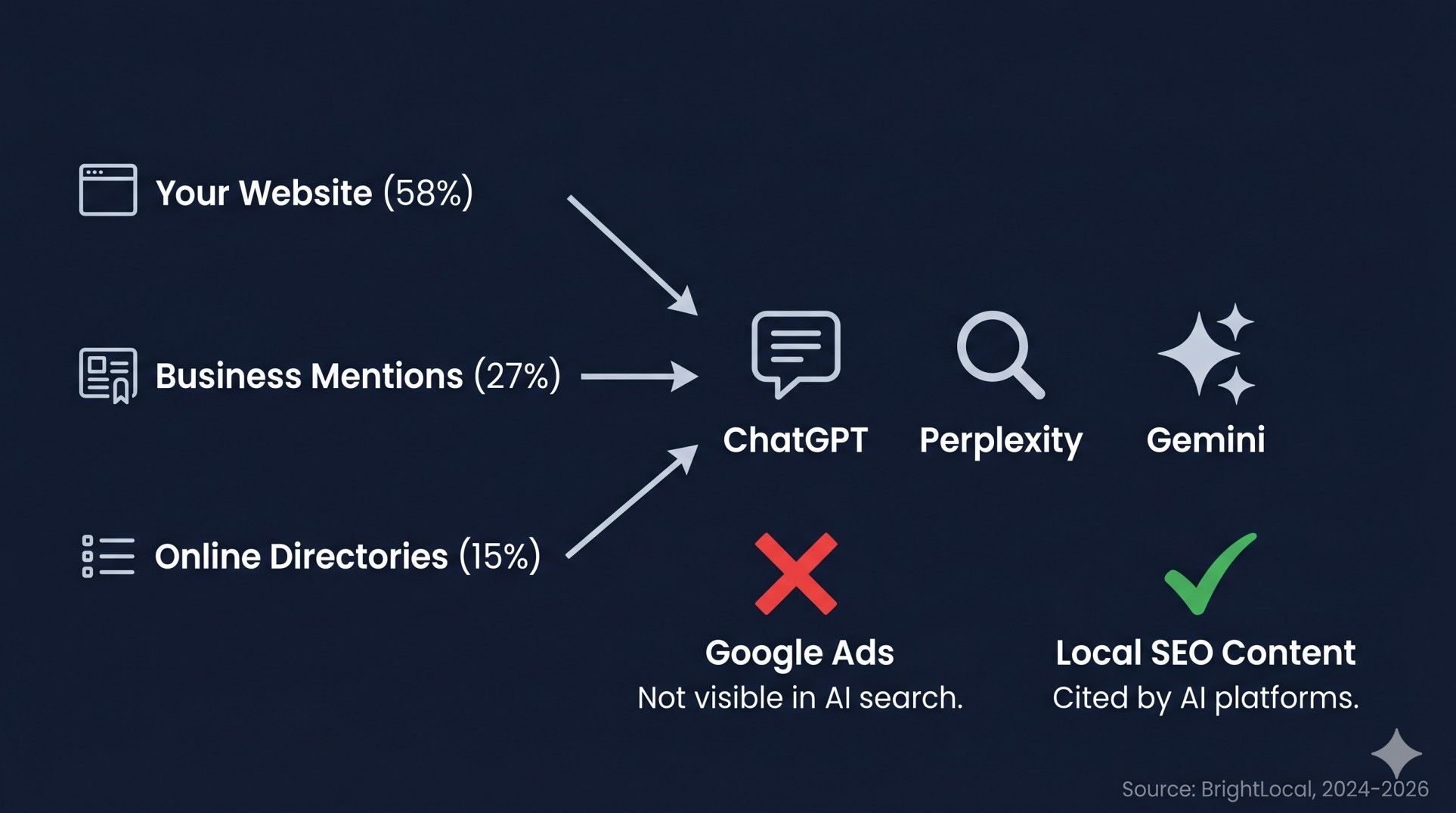
Google Ads are invisible to AI search. When someone asks ChatGPT "who is the best plumber in Denver?" or asks Perplexity "find me an HVAC company near me," paid ads do not appear in those results. AI platforms pull from organic content — websites, blog posts, review sites, and business directories.
Local SEO content gets cited by AI platforms. According to BrightLocal's local SEO statistics page, ChatGPT Search shows business websites as the source for 58% of its local search recommendations. Business mentions on other sites account for 27%, and online directories account for 15%. This is exactly why citation building and authority backlinks matter more than ever.
AI visibility is harder to earn. The SOCi Local Visibility Index (2026), as cited by BrightLocal, found that visibility in local recommendations by ChatGPT is 30 times harder to achieve than ranking in Google's local search results. Less than half of businesses that lead in Google local search also appear in AI local recommendations.
AI recommendations favor well-reviewed businesses. BrightLocal also reports that recommended local businesses have an average of 4.3 stars on ChatGPT, 4.1 on Perplexity, and 3.9 on Gemini. This makes review management a critical component of any AI visibility strategy.
According to BrightLocal's Local Search Ranking Factors (2025), experts say local AI search visibility is most influenced by three factors: presence on expert-curated "Best Of" lists, dedicated pages for each service, and prominence on key industry-relevant domains. All three are local SEO activities, not paid advertising.
This means that a strong local SEO strategy — with quality content, robust citations, strong reviews, and local authority — is becoming the only way to stay visible as search behavior shifts toward AI platforms.
If you are only running Google Ads with no organic presence, you are invisible to a growing share of your potential customers. For a deeper dive into how to get found on Google Maps and AI search, check out our comprehensive local SEO service.
The 5-Step Decision Framework
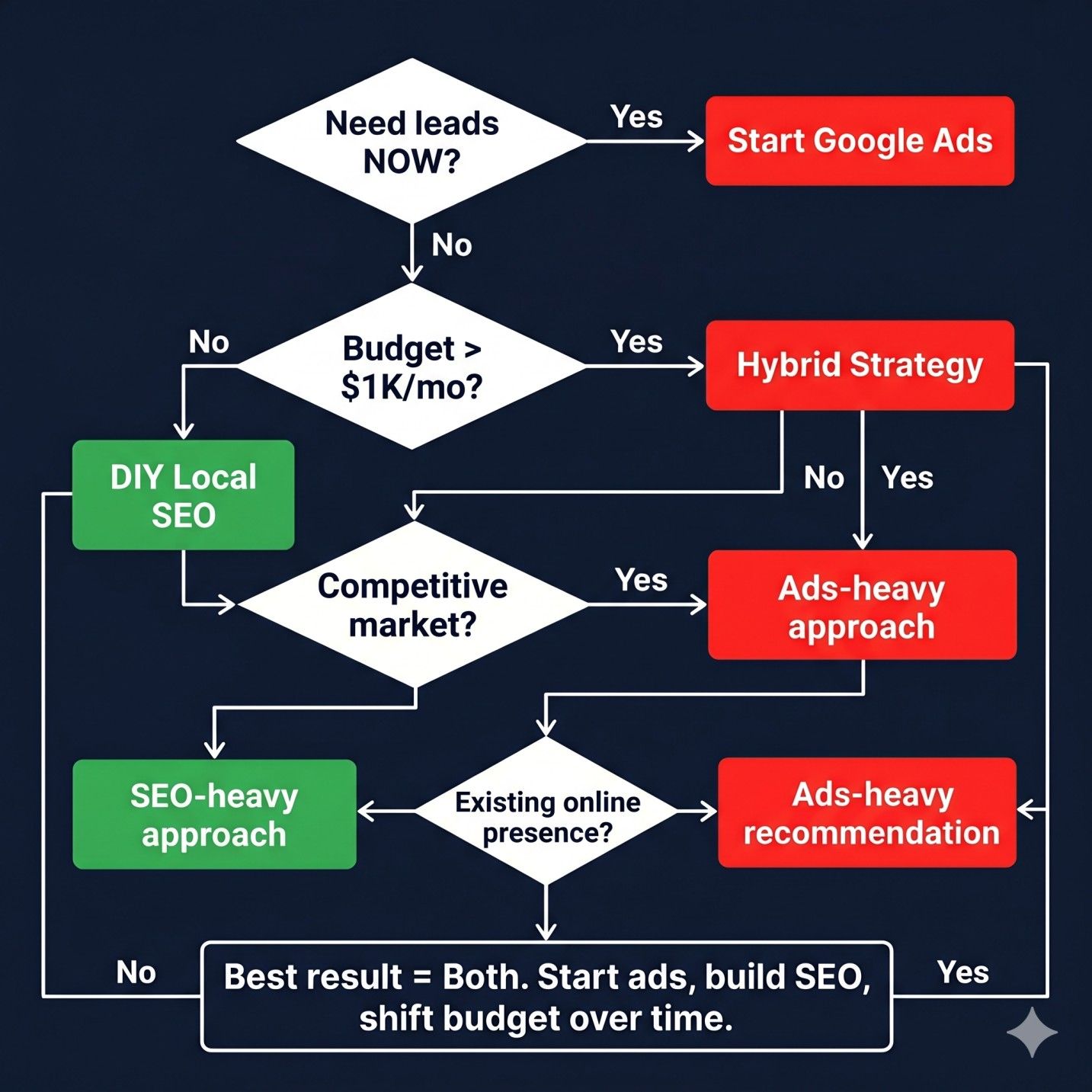
Not sure which strategy is right for you right now? Work through these five questions:
Step 1: How urgent is your need for leads?
- Need leads this week → Start with Google Ads
- Can wait 3-6 months → Start with local SEO
- Need some now but building for the future → Hybrid approach
Step 2: What is your monthly marketing budget?
- Under $1,000/month → Focus 100% on local SEO (start with our free resources and checklists)
- $1,000–$3,000/month → Hybrid approach with heavier SEO allocation
- $3,000–$5,000+/month → Full hybrid strategy with phased ad reduction
Step 3: How competitive is your local market?
- Low competition (small town, few competitors) → SEO alone may be enough
- Medium competition → Hybrid approach
- High competition (major metro, saturated market) → Ads for immediate presence while SEO builds
Step 4: How long have you been in business?
- Brand new (under 6 months) → Ads first, SEO in parallel
- Established (1-3 years) → Shift toward SEO dominance
- Mature (3+ years with existing online presence) → Double down on SEO, use ads surgically
Step 5: Do you have an existing online presence?
- No website, no reviews, no GBP → Ads first while building your SEO foundation
- Website exists but not ranking → Hybrid approach with site optimization
- Already ranking for some keywords → Invest heavily in SEO to expand, reduce ad spend
Get a Free Local SEO Audit
Whether you are spending too much on Google Ads with shrinking returns, or you have not started with local SEO yet, we can help you build a strategy that makes sense for your business.
At LocalHero, we specialize in local SEO for service businesses. We help plumbers, HVAC companies, roofers, lawyers, dentists, and other local businesses get visible on Google Maps, organic search, and AI platforms—without wasting money on ads that stop working the moment you stop paying.
Here is what you get with our free audit:
- Analysis of your current Google Ads spend efficiency (if applicable)
- Review of your Google Business Profile optimization
- Local keyword opportunity assessment
- Competitor visibility comparison
- Custom recommendation: where your marketing dollars will have the highest impact
No sales pitch. No commitment. Just a clear, data-backed picture of where you stand and what to do next.
Frequently Asked Questions
Is local SEO cheaper than Google Ads?
In the short term, no. Local SEO requires upfront investment that may not generate immediate returns. But over time, local SEO almost always becomes cheaper per lead. After 12-18 months of consistent effort, organic leads can cost a fraction of what paid leads cost because your rankings, reviews, and content assets generate traffic without ongoing per-click costs. A service business spending $2,000/month on SEO for a year may reach a point where organic leads cost under $30 each — while Google Ads leads in the same market might still cost $100-$167 per lead, based on SearchLight Digital's 2026 benchmarks.
Can I do local SEO myself or do I need an agency?
You can absolutely handle some local SEO tasks yourself — especially claiming and optimizing your Google Business Profile (use our GBP checklist to get started), asking customers for reviews, and making sure your business information is consistent across directories. However, the more technical and strategic aspects like building local backlinks, creating optimized content, implementing schema markup, and tracking rankings typically benefit from professional help. If you have the budget, partnering with a local SEO agency lets you focus on running your business while professionals handle visibility.
Should I stop Google Ads once my SEO is working?
Not necessarily. The smartest approach is to reduce ad spend gradually as organic leads increase, but keep ads running for strategic purposes. Use ads for high-urgency keywords where you want guaranteed top-of-page visibility, for new service areas where you have not yet built organic rankings, and for seasonal spikes where demand temporarily outpaces what organic traffic can deliver. Think of it as shifting from ads as your primary lead source to ads as a tactical supplement.
How long does it take for local SEO to outperform Google Ads?
For most service businesses, the crossover point happens between month 6 and month 12. By month 6, local SEO typically starts generating enough organic leads to offset a meaningful portion of your ad spend. By month 12, many businesses find that organic leads outnumber paid leads. The exact timeline depends on your market competition, the quality of your SEO execution, and how many reviews you collect. Businesses in less competitive markets may see the crossover sooner. Businesses in major metros with aggressive competitors may take longer.
Do Google Ads help my SEO rankings?
No, Google Ads do not directly improve your organic rankings. Google has confirmed this many times. However, ads can indirectly benefit your SEO in a few ways. Ad traffic to your website increases brand awareness, which can lead to more branded searches (people Googling your business name). Ad data reveals which keywords convert best, which helps you prioritize your SEO content strategy. And running ads can generate initial customers whose reviews strengthen your Google Business Profile — which is a direct local ranking factor.
About the author
Ashikur Rohoman
Md Ashikur Rohoman is the founder of LocalHero, a local SEO agency that helps service businesses rank higher on Google and get more calls. He's worked with plumbers, dentists, lawyers, and HVAC companies across the US to build real local visibility through backlinks, citations, and Google Business Profile optimization. Connect with him on LinkedIn
Ready to rank higher on Google Maps?
Get a free audit of your website, Google Business Profile, reviews, and local rankings. No strings attached.
Get my free audit