Local SEO Backlinks: 7 Free Ways to Build Them (Small Business Guide)
Table of Contents
Local SEO Backlinks: 7 Free Ways Small Businesses Can Build Them Without Spending a Dollar
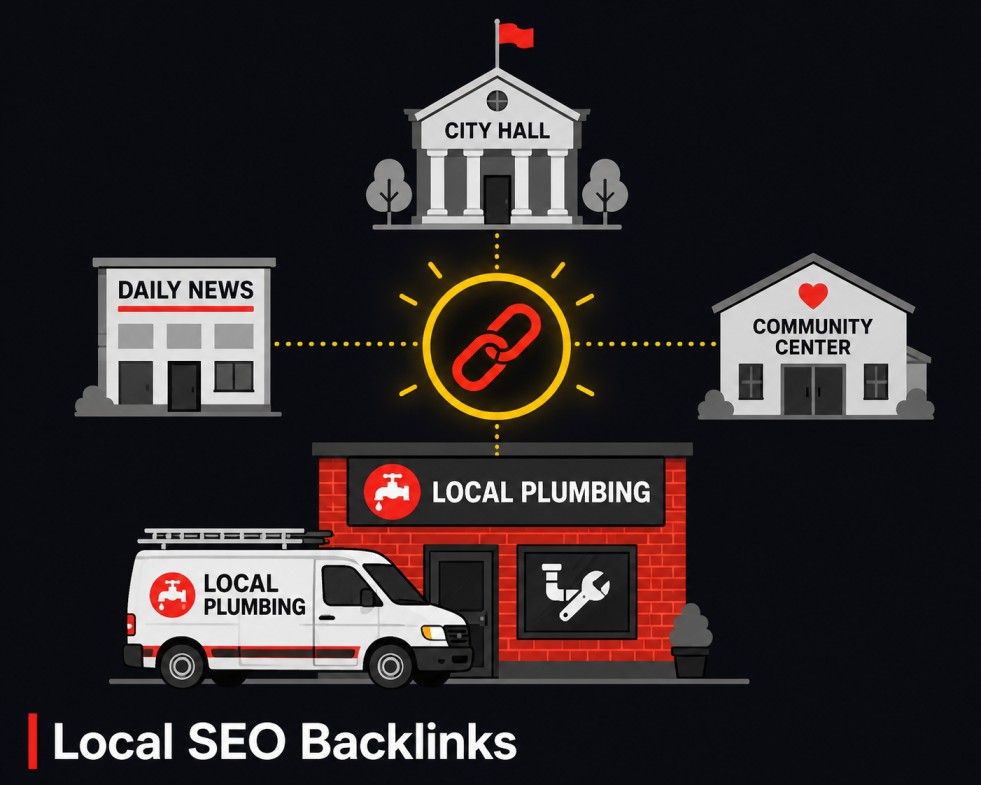
Most small service businesses skip link building entirely. And honestly? That is why their competitors keep outranking them on Google Maps — even when those competitors have fewer reviews and a worse website.
Local SEO backlinks are one of the top 5 ranking factors for local search. But you do not need a big budget or an SEO agency to get them. You just need to know where to look.
This guide covers 7 free ways to build local SEO backlinks — the kind Google actually trusts.
1. What is a local SEO backlink?
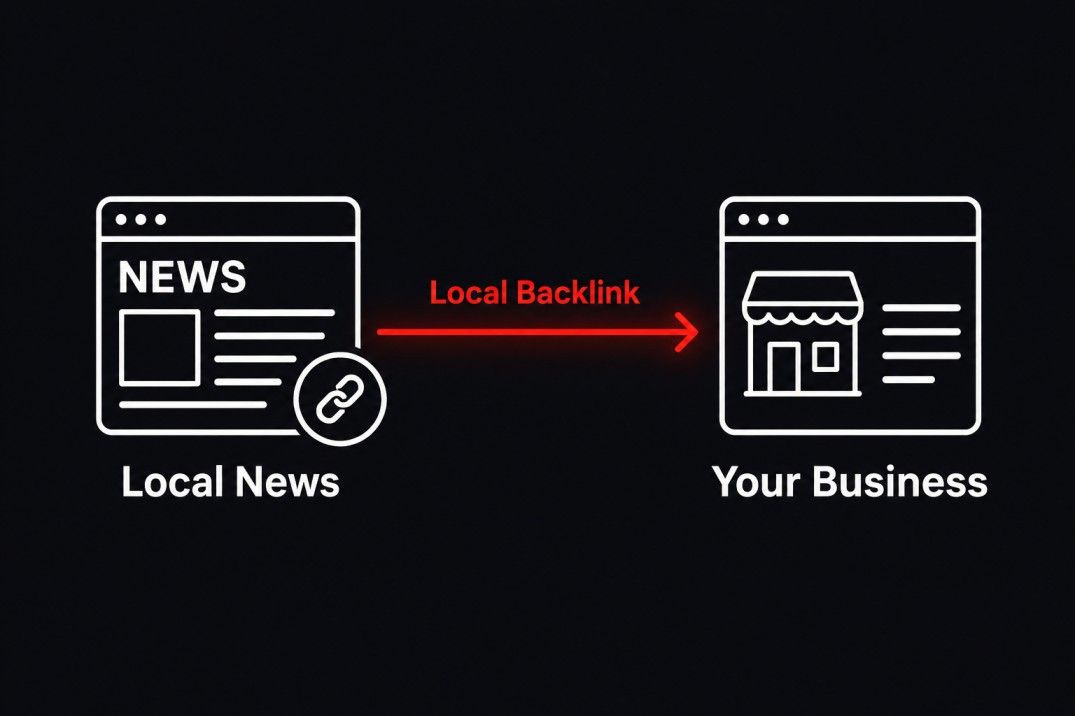
A local SEO backlink is a link from another website to yours — where that website is connected to your city, your industry, or both.
For example, if a local news site writes a story about your roofing company and links to your website, that is a local backlink. If your city's Chamber of Commerce lists your business with a link, that is a local backlink too.
The difference between a local backlink and a regular backlink is relevance. Google sees a link from a local plumbing directory or a neighborhood blog as much stronger proof that your business is real and trusted in your area.
2. Why local SEO backlinks matter for your Google Maps ranking
When someone searches "plumber near me" or "HVAC company in Dallas," Google decides who shows up in the Map Pack based on three things: relevance, distance, and prominence.
Local SEO backlinks directly build your prominence score — Google's measure of how well-known and trusted your business is. A business with 10 high-quality local backlinks from a chamber of commerce, local news sites, and community organizations will consistently outrank a competitor with 200 irrelevant directory links.
That is good news for small businesses. You do not need hundreds of links. You need the right ones.
90% of local SEO experts rate link quality and diversity as valuable ranking factors. 75% value links from community sites, and 70% value local news sources.
And it goes beyond Google. AI models like Google Gemini and ChatGPT use backlinks as a primary verification signal. If top-tier sites link to you, AI models are far more likely to cite your brand as the definitive source in their generated answers.
So the same links that help you rank on Google Maps also help you show up when someone asks ChatGPT or Perplexity for a recommendation.
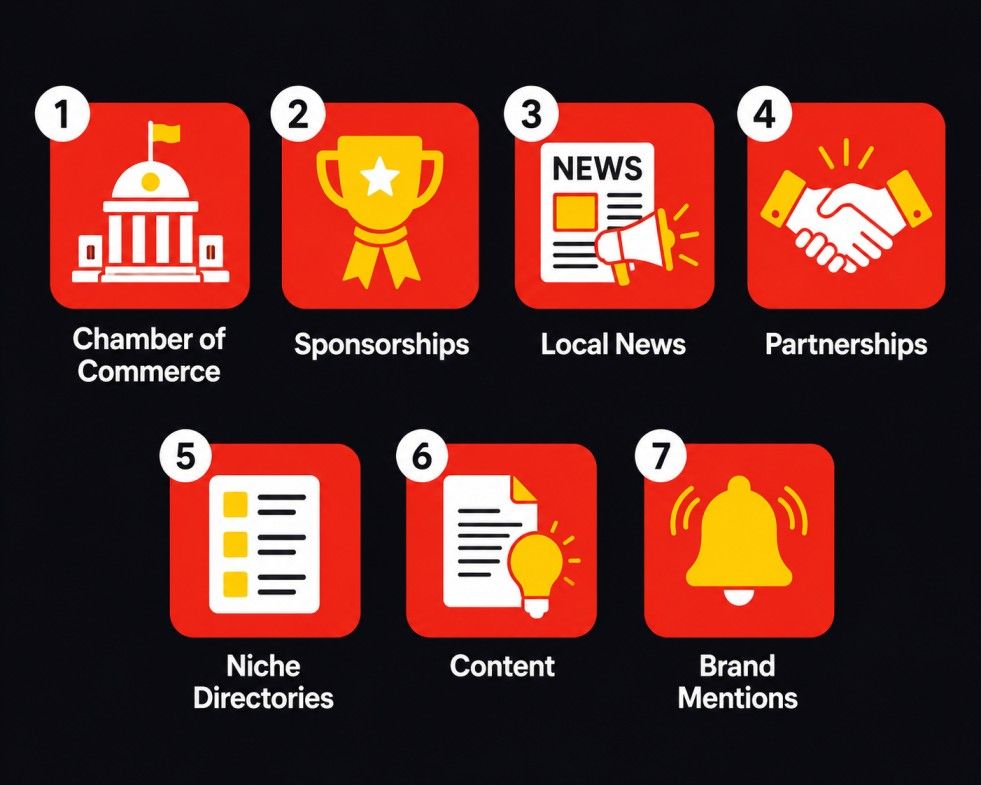
3. 7 ways to get local SEO backlinks for free
1. Get listed in your city's Chamber of Commerce
This is the single easiest high-quality local backlink you can get. Most chambers of commerce have a member directory on their website with a link to your site.
Annual membership usually costs $100–$300. For SEO purposes, that is one of the best investments you can make — a link from a .org or government-adjacent site in your city sends a very strong local authority signal to Google.
How to do it: Search "[your city] chamber of commerce" → click "Join" or "Become a member."
2. Sponsor a local event, team, or charity
Local event websites, school sports teams, nonprofit sites, and community organizations almost always list their sponsors with a link. You get a real local backlink. They get funding. Everyone wins.
42% of local link-building campaigns involve sponsorships or charitable collaborations.
Sponsorships do not have to be expensive. Many local little league teams, charity runs, and school events have sponsorship tiers starting at $100–$200.
How to find opportunities: Search "[your city] events sponsors" or "[your city] nonprofit sponsors" — look for sites that list sponsors by name with links.
3. Get featured in local news
A single link from your local newspaper or news website is worth more than 50 links from random directories.
You do not need to do something newsworthy to get covered. Reporters always need local business owners to comment on topics like rising costs, local hiring trends, or seasonal demand.
How to do it:
• Search "[your city] business reporter" on LinkedIn and connect
• Sign up for Connectively (free version) — journalists post requests for expert sources daily
• Send a short pitch: "I'm a local [plumber/HVAC tech/roofer] and available to comment on [topic] for any upcoming stories"
One placement in a local outlet builds more authority than months of directory submissions.
4. Build partnerships with businesses that serve the same customers
Think about who else your customers hire. A plumber's customers also hire electricians, roofers, and general contractors. An HVAC company's customers also hire plumbers and home inspectors.
None of those businesses compete with you directly. But they all serve the same homeowners — which makes them perfect link partners.
How to do it: Reach out to 5 non-competing local businesses in your space. Offer to recommend each other on your websites. A simple "Recommended local businesses" page with links goes both ways and costs nothing.
This also works for property managers, real estate agents, and home builders — all of whom regularly refer service businesses to their clients.
5. List your business in niche industry directories
Generic directories like Yelp and Yellow Pages barely move the needle anymore. What works is getting listed in industry-specific directories — the ones your target customers actually use.
|
Industry |
Best Free Directories to Get Listed In |
|
Plumbers |
Angi, Thumbtack, HomeAdvisor |
|
HVAC |
ACCA Member Directory, Carrier Dealer Locator |
|
Roofers |
NRCA Member Directory, RoofingContractor.com |
|
Attorneys |
Avvo, FindLaw, Justia |
|
Dentists |
Healthgrades, Zocdoc, 1-800-Dentist |
|
Electricians |
IEC Member Directory, Angi |
|
Auto Repair |
RepairPal, ASE Shop Locator |
|
Cleaning |
HomeAdvisor, Handy, Thumbtack |
Each listing is a backlink. More importantly, each listing is a consistent NAP citation — your business name, address, and phone number — which also strengthens your Google Maps ranking directly.
If you want help auditing your current citations and finding missing ones, run a free local SEO audit — it takes 30 seconds.
6. Write one useful piece of content your city will link to
Most link building advice focuses on outreach. But the easiest way to get links is to create something people want to reference.
For a local service business, this does not need to be complicated. One well-written, genuinely useful resource can earn links from local blogs, news sites, and community pages for years.
Good examples for service businesses:
• "How to prepare your home for a [city] winter" (HVAC, plumber)
• "What to do when your roof gets damaged in a [city] hailstorm" (roofer)
• "How much does a dental cleaning cost in [city] in 2026?" (dentist)
• "The [city] homeowner's guide to electrical safety" (electrician)
Make it specific to your city. Include real local details. That is what makes it linkable — and what makes it rank.
See how we build authority backlinks for service businesses: authority backlinks service.
7. Claim unlinked brand mentions
This one is often overlooked. As your business gets mentioned in reviews, local Facebook groups, and community forums, sometimes those mentions do not include a link to your website.
Those are easy backlinks waiting to be claimed.
How to find them: Set up a free Google Alert for your business name (go to google.com/alerts). When you get a notification that someone mentioned you without linking to your site, send a short, friendly email asking if they would mind adding a link. Most people say yes.
4. Which local SEO backlinks are worth your time?
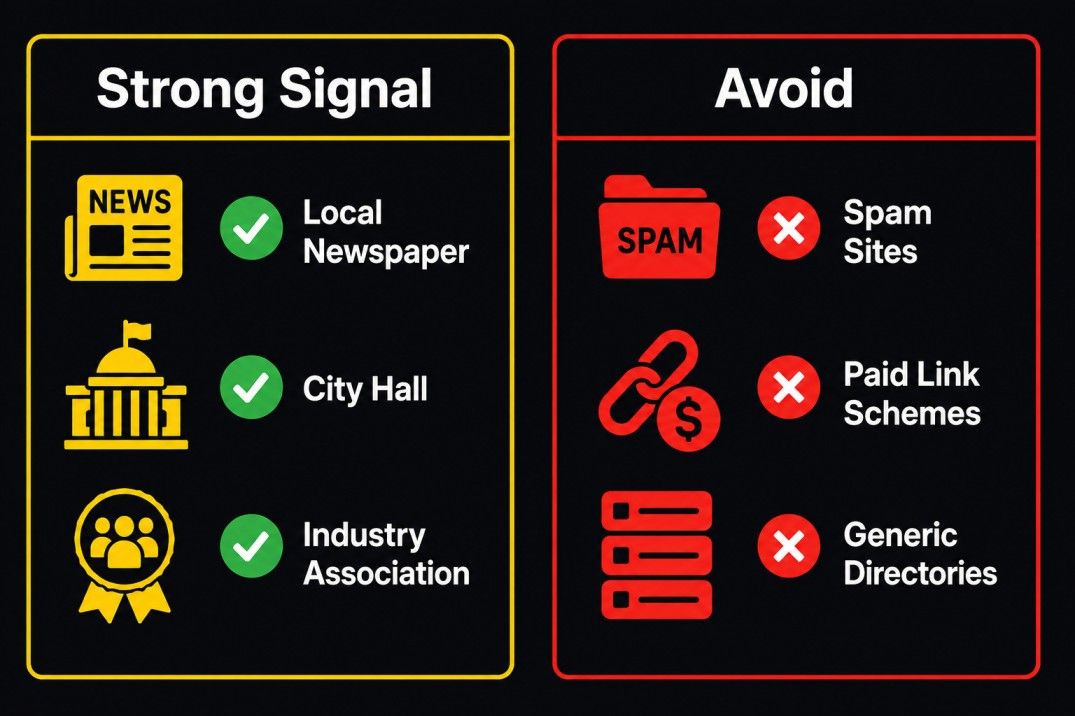
Not all links are equal. Here is a simple way to judge whether a potential link is worth pursuing:
Strong signal — pursue these:
• Local newspaper or news website
• Chamber of Commerce directory
• City or county government website (.gov)
• Industry association directory
• Local university or college site (.edu)
• A real local business with actual customers
Weak signal — low priority:
• Generic web directories with no real traffic
• Sites that list hundreds of unrelated businesses
• Any site that asks you to pay per link
Avoid entirely:
• PBN links (private blog networks)
• Fiverr link packages
• Any site that exists only to sell backlinks
The goal is not to collect as many links as possible. The goal is to build a backlink profile that looks like a real, trusted local business — because that is what Google and AI search engines reward.
5. How long before you see results?
Most local businesses start seeing movement in their Google Maps ranking within 60–90 days of consistent link building. Full results — like moving into the top 3 on the Map Pack — usually take 4–6 months.
The businesses that see results fastest are the ones that combine link building with a fully optimized Google Business Profile and a steady flow of new reviews. Links alone move the needle. Links plus a strong GBP moves it much faster.
If you want to see where you stand right now — which links you have, which citations are wrong, and what your Google Business Profile is missing — get a free local SEO audit. It scores your site across 17 local SEO factors in 30 seconds.
Related guides
How to show up in Google's Map Pack
Google Business Profile checklist for local businesses
Local SEO checklist for small businesses
Our authority backlinks service
Frequently Asked Questions
What are local SEO backlinks for small business?
Local SEO backlinks are links from other websites to yours, where those sites are connected to your city, your industry, or both. They tell Google your business is real, active, and trusted in a specific area — which directly improves your Google Maps ranking.
How many backlinks does a small business need to rank locally?
Most local businesses need far fewer links than you think. The average number of referring domains needed to rank in the local top 10 is around 125 — but it varies heavily by market. For many trades in mid-sized cities, 20–50 quality local backlinks is enough to compete.
Are free backlinks as good as paid ones?
Yes — often better. A free link from your local Chamber of Commerce or a news mention is far more valuable than a paid link from a generic directory. Google values relevance and trust, not how much you spent.
What is the difference between a citation and a local backlink?
A citation is any online mention of your business name, address, and phone number — with or without a link. A backlink is a clickable link from another site to yours. Both help your local ranking, but backlinks carry more authority weight. Citations confirm you exist. Backlinks confirm you are trusted.
Can local SEO backlinks help me show up in AI search results?
Yes. When someone asks ChatGPT, Perplexity, or Google AI Overviews for a local service recommendation, those systems pull from trusted sources across the web. The same links that improve your Google Maps ranking also make it more likely that AI tools will mention your business by name.
How do local sponsorships help with backlinks?
When you sponsor a local event, sports team, or charity, their website typically lists you as a sponsor with a link to your site. That link comes from a real local organization, which Google treats as a strong local authority signal.
Post-Publish Checklist
• Add slug: local-seo-backlinks in Directus
• Add 301 redirect in next.config.mjs: /blog/5-simple-hacks-for-local-link-building → /blog/local-seo-backlinks
• Upload cover image (Image 1) to Directus cover image field
• Request indexing in GSC URL Inspection same day as publish
• Add internal link to this post from /services/local-seo page
• Add internal link from at least 2 existing blog posts
• Update meta description on 4 old posts (see audit findings)
Image Generation Prompts
Use Ideogram 2.0 for all images. Upload to Directus as cover image and in-body images. Recommended size: 1200 × 630px (16:9).
Image 1 — Cover / Hero Image
Placement: Cover image field in Directus (OG image for social sharing)
Prompt:
Flat illustration of a small local business — a plumbing van parked outside a brick storefront — with a glowing chain-link icon floating above it connected to three other local buildings: a newspaper office, a city hall with a flag, and a community center. Dark background #121216. Red accent #FF1E26. Yellow highlight #FFCC00. Clean bold lines, no gradients, no stock photography style. Text overlay bottom-left: "Local SEO Backlinks" in white sans-serif. Style: modern flat infographic illustration. High contrast. No people.
Negative prompt: photorealistic, stock photo, blur, gradient background, people, faces, 3D render, neon
Color reference: Background #121216 | Primary accent #FF1E26 | Highlight #FFCC00 | Text white
Image 2 — What is a Local Backlink (Section Illustration)
Placement: After the 'What is a local backlink?' H2 heading
Prompt:
Minimal flat diagram showing two websites connected by an arrow — left side: a local news site icon labeled 'Local News' with a chain-link symbol, right side: a small business website icon labeled 'Your Business'. Arrow between them glowing red #FF1E26 labeled 'Local Backlink'. Dark background. Clean white labels. Style: technical diagram illustration, flat design. No people, no gradients.
Negative prompt: photorealistic, 3D, shadows, people, complex backgrounds
Image 3 — The 7 Methods Overview (Numbered Visual)
Placement: Before or after the intro of the '7 ways' section
Prompt:
Flat infographic showing 7 numbered icons in two rows on a dark #121216 background. Each icon represents a method: 1) a city building with a flag (Chamber of Commerce), 2) a trophy/ribbon (sponsorship), 3) a newspaper with a megaphone (local news), 4) two handshake icons (partnerships), 5) a directory/list icon (niche directories), 6) a document with a lightbulb (content), 7) a bell notification icon (brand mentions). Each icon in a red #FF1E26 rounded square with a white number badge. Yellow #FFCC00 used for highlights. Bold white labels below each icon. Clean, no gradients.
Negative prompt: photorealistic, people, complex textures, gradients, 3D
Image 4 — Chamber of Commerce (Step 1)
Placement: Next to or below the Chamber of Commerce section
Prompt:
Flat illustration of a local government-style building with columns and an American flag, labeled 'Chamber of Commerce'. A glowing chain-link badge in red #FF1E26 appears on the building facade with a checkmark. Dark background #121216. Yellow highlight on the badge. Clean bold lines, minimalist, no people. Style: flat icon illustration scaled to infographic.
Negative prompt: photorealistic, people, faces, 3D shadows, gradients
Image 5 — Backlink Quality Guide (Good vs Avoid)
Placement: Beside or below the 'Which local backlinks are worth your time?' section
Prompt:
Two-column flat comparison infographic on dark #121216 background. Left column header 'Strong Signal' with green checkmark badges listing: local newspaper icon, city hall icon, industry association badge. Right column header 'Avoid' with red X badges listing: a spam folder icon, a dollar sign link icon, a generic directory stack. Bold white labels. Red #FF1E26 for right column accents, yellow #FFCC00 for left column highlights. Clean, flat, no gradients, no people.
Negative prompt: photorealistic, people, gradients, 3D render, neon glow
General Ideogram 2.0 Settings for All Images
• Aspect ratio: 16:9 (1200 × 630px)
• Style: Flat illustration / infographic
• Model: Ideogram 2.0
• Magic prompt: OFF (use prompts verbatim)
• Color palette lock: Background #121216, Red #FF1E26, Yellow #FFCC00, White text
Frequently Asked Questions
What exactly are local authority backlinks?
Local authority backlinks are links to your website from reputable, established organizations or businesses within your specific geographic area. Unlike general backlinks, these come from sources like local news outlets, chambers of commerce, local government (.gov) sites, or community blogs. They are highly valuable because they signal to search engines that your business is a trusted and relevant part of the local community.
Why are local backlinks more important for SEO than global ones?
While global backlinks help with overall domain authority, local backlinks are the primary driver for "Local Pack" rankings on Google Maps. They provide "geographical relevance," helping Google understand exactly where your business operates. A single link from a well-known local charity or town council can often carry more weight for local search rankings than several generic links from unrelated national websites.
What are the best ways to earn these links?
Sponsorships: Supporting local sports teams, events, or charities. Local PR: Reaching out to local journalists with stories about community impact or business milestones. Business Directories: Ensuring you are listed in high-quality, niche-specific local directories. Partnerships: Exchanging mentions or guest posts with non-competing businesses in your area.
How do I know if a local site is a "high authority" source?
A high-authority local source doesn't necessarily need a high global "Domain Authority" score. Instead, look for: Trust: Is it a recognized local institution (like a library, school, or news site)? Activity: Is the site updated regularly with local content? Traffic: Does the site actually receive visits from people in your city or region? Relevance: Is the site’s audience the same people you are trying to reach?
Can I get penalized for building local backlinks?
You only risk a penalty if you use "spammy" tactics, such as buying bulk links from low-quality link farms or using automated software. To stay safe and effective, focus on earned links through genuine community involvement and relationship building. Google rewards links that appear natural and provide actual value to local users.
What are local SEO backlinks for small business?
Local SEO backlinks are links from other websites to yours, where those sites are connected to your city, your industry, or both. They tell Google your business is real, active, and trusted in a specific area — which directly improves your Google Maps ranking.
How many backlinks does a small business need to rank locally?
Most local businesses need far fewer links than you think. The average number of referring domains needed to rank in the local top 10 is around 125 — but it varies heavily by market. For many trades in mid-sized cities, 20–50 quality local backlinks is enough to compete.
Are free backlinks as good as paid ones?
Yes — often better. A free link from your local Chamber of Commerce or a news mention is far more valuable than a paid link from a generic directory. Google values relevance and trust, not how much you spent.
What is the difference between a citation and a local backlink?
A citation is any online mention of your business name, address, and phone number — with or without a link. A backlink is a clickable link from another site to yours. Both help your local ranking, but backlinks carry more authority weight. Citations confirm you exist. Backlinks confirm you are trusted.
Can local SEO backlinks help me show up in AI search results?
Yes. When someone asks ChatGPT, Perplexity, or Google AI Overviews for a local service recommendation, those systems pull from trusted sources across the web. The same links that improve your Google Maps ranking also make it more likely that AI tools will mention your business by name.
How do local sponsorships help with backlinks?
When you sponsor a local event, sports team, or charity, their website typically lists you as a sponsor with a link to your site. That link comes from a real local organization, which Google treats as a strong local authority signal.
About the author
Ashikur Rohoman
Md Ashikur Rohoman is the founder of LocalHero, a local SEO agency that helps service businesses rank higher on Google and get more calls. He's worked with plumbers, dentists, lawyers, and HVAC companies across the US to build real local visibility through backlinks, citations, and Google Business Profile optimization. Connect with him on LinkedIn
Ready to rank higher on Google Maps?
Get a free audit of your website, Google Business Profile, reviews, and local rankings. No strings attached.
Get my free audit