Local SEO for HVAC Companies: The Complete Guide to Getting More Service Calls
Table of Contents
Introduction
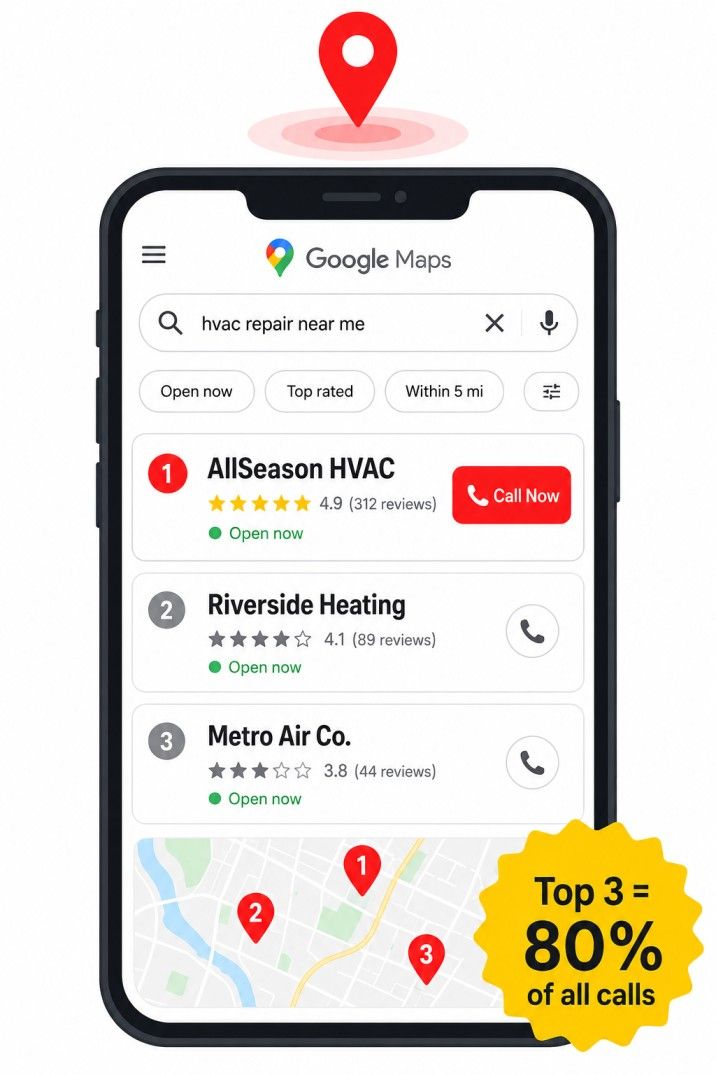
Your phone should be ringing. You have the trucks, the technicians, and years of experience. But when a homeowner in your city types "AC repair near me" at 9 PM on a Saturday, your business doesn't show up. A competitor with half your experience gets that call.
That's not bad luck. That's a local SEO problem — and it's 100% fixable.
HVAC is one of the most competitive local search markets in the US. Every city has dozens of heating and cooling companies fighting for the same top three Google Map Pack spots. The businesses in those spots aren't better at HVAC than you are. They're just better at local SEO.
This guide gives you the exact system to change that. We'll cover your Google Business Profile, website structure, review strategy, citations, and the competitive moves that push you above the contractors currently sitting above you.
Why HVAC Companies Struggle on Google
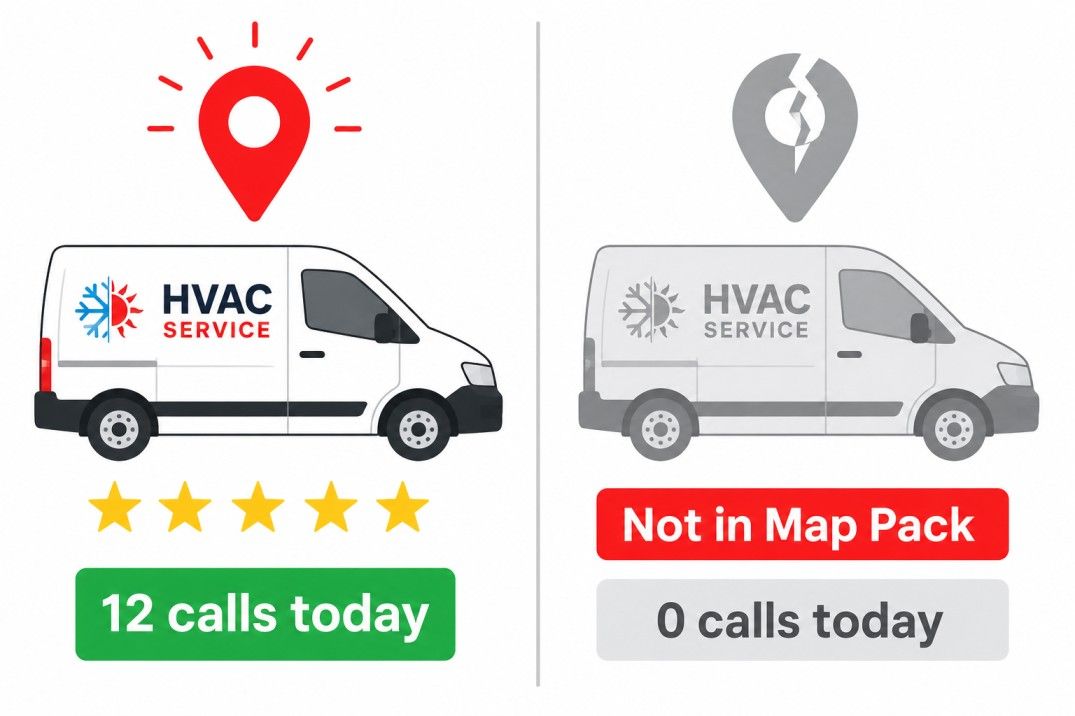
Most HVAC companies have the same local SEO problem: they treat their website like a digital business card and their Google Business Profile like a yellow pages listing. They fill in the basics, then move on.
That approach worked in 2015. It doesn't work now.
Google's local algorithm in 2026 rewards businesses that look alive, trusted, and relevant. A profile with no recent photos, no weekly posts, and reviews that stopped coming in three months ago signals to Google that this company may not be actively serving customers. Rankings fall, quietly and steadily.
Here's what's also true: 97% of HVAC customers search online before making a decision. When your AC breaks in July, people aren't calling the company on a magnet stuck to their fridge. They're Googling. They're calling the first name they see on the map.
The HVAC companies losing leads in 2026 are losing them because of three consistent mistakes:
- An incomplete or neglected Google Business Profile. Missing hours, no photos added in months, no posts, unanswered questions.
- A website with no dedicated service or location pages. One "Services" page that lists everything isn't the same as ten targeted pages that each rank for a specific query.
- Inconsistent or nonexistent review collection. Seasonal businesses flood with reviews in summer and go silent in winter. Google notices.
Fix these three things and you will outrank most of your competitors. Most of them are not doing the work.
How Google Ranks HVAC Contractors Locally
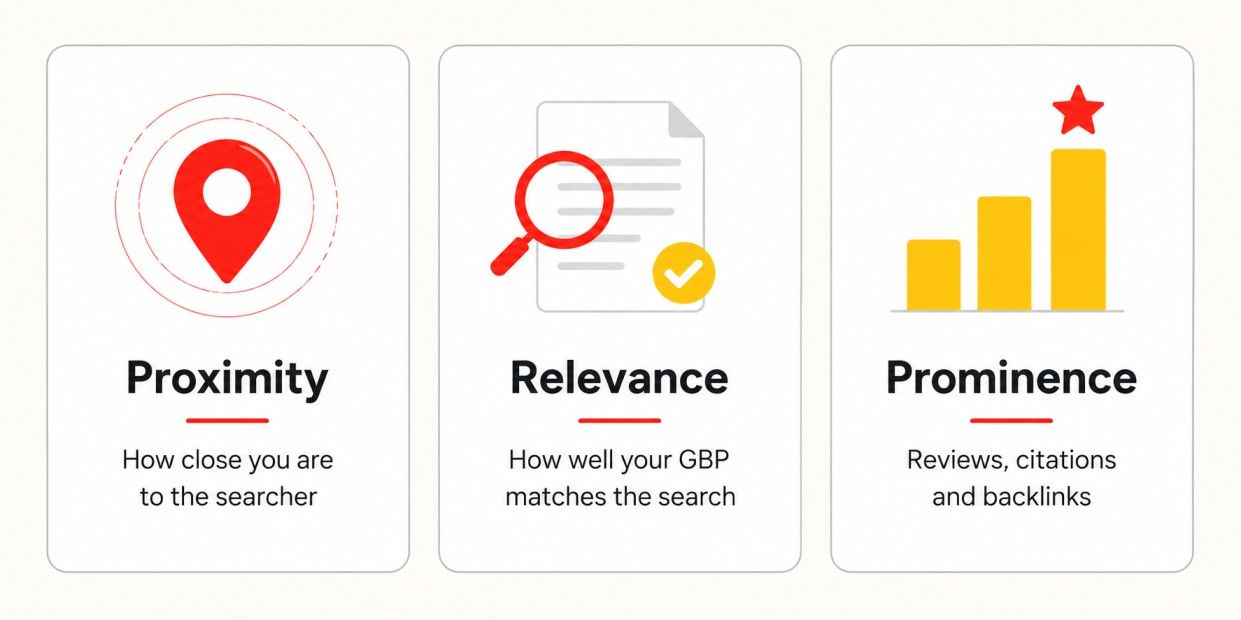
Google uses three factors to decide which HVAC companies appear in the Map Pack (the top three results with the map):
Proximity — How close your verified business address is to the person searching. You can't move your shop, but you can optimize your service area settings and create location pages to extend your reach.
Relevance — How well your Google Business Profile and website match what the person is searching for. Categories, services listed, and content on your website all feed this signal.
Prominence — Your overall reputation and authority. Reviews, citations, backlinks, and how often your business appears across the web.
Proximity is mostly fixed. Relevance and prominence are where you win.
Step 1: Optimize Your Google Business Profile
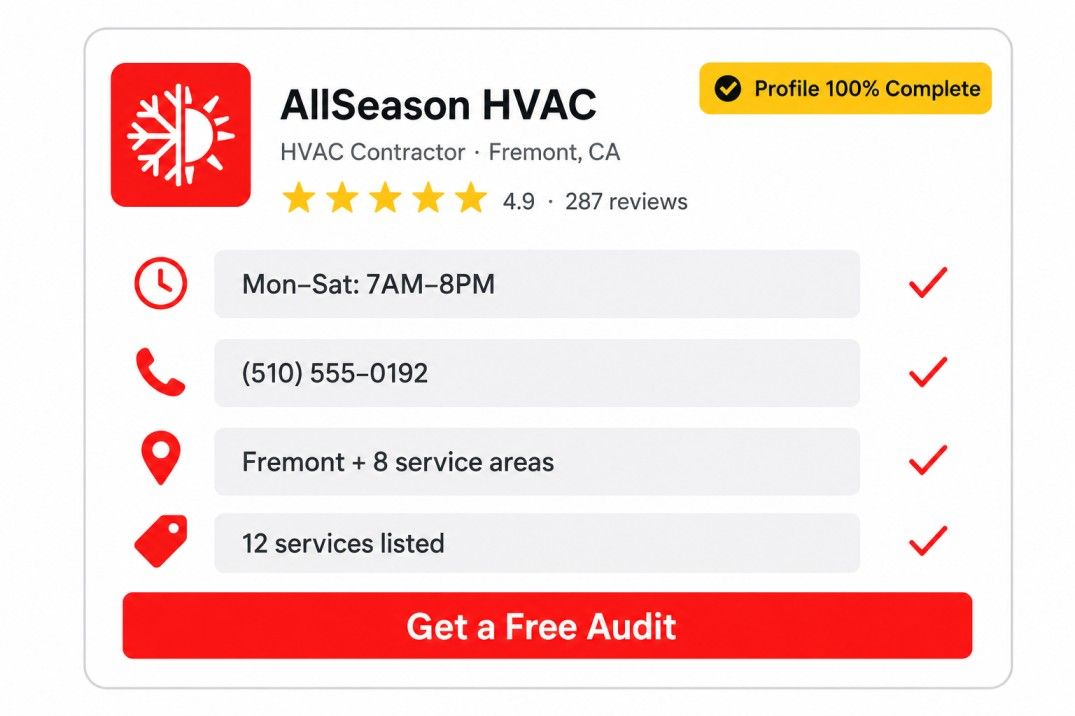
Your Google Business Profile (GBP) is the single highest-leverage asset in local SEO. It's free, it controls your Map Pack visibility, and most HVAC companies have one that's only 60–70% complete.
Choose the Right Primary Category
Your primary category is the most important field on your entire profile. For most HVAC companies, the right choice is "HVAC contractor." Don't choose "Air conditioning repair service" as your primary — that's too narrow. Don't choose "Heating contractor" — that excludes cooling.
Add secondary categories to cover everything you do: "Air conditioning repair service," "Furnace repair service," "Heat pump supplier," "Air duct cleaning service."
Fill Every Single Field
Google favors profiles that are 100% complete. That means:
- Business description (up to 750 characters — use it all, mention your city and main services naturally)
- Hours including holiday hours
- Phone number (use a local number, not an 800 number)
- All services listed with descriptions
- All applicable attributes (financing available, emergency service, licensed, insured)
- Opening date
Upload Real Photos Every Month
Businesses that upload photos consistently see significantly more calls and direction requests than those that don't. Upload:
- Exterior photos of your trucks and office
- Photos from real job sites (with customer permission)
- Team photos
- Before/after shots where applicable
In 2026, Google is also pushing short vertical videos on Business Profiles. Upload a 30-second walk-through of a real service call if you can.
Post Weekly
Create a GBP post every week without exception. Use three types:
- What's New: Seasonal tips, equipment news, behind-the-scenes
- Offers: Time-limited discounts or tune-up packages
- Updates: Business news, certifications, new service areas
Posts expire after 7 days, so consistency matters. Block 20 minutes every Monday to write and post. It takes less time than it sounds once it's a routine.
Seed Your Q&A Section
Anyone can post questions in your Q&A section — including competitors. Get ahead of it. Post and answer the 8–10 questions you actually hear on the phone:
- "Do you service [Brand] equipment?"
- "Do you offer financing?"
- "What's your emergency service fee?"
- "Are you licensed and insured in [State]?"
Answering these yourself controls the narrative and gives Google useful content to index.
Step 2: Build Your Service and Location Pages
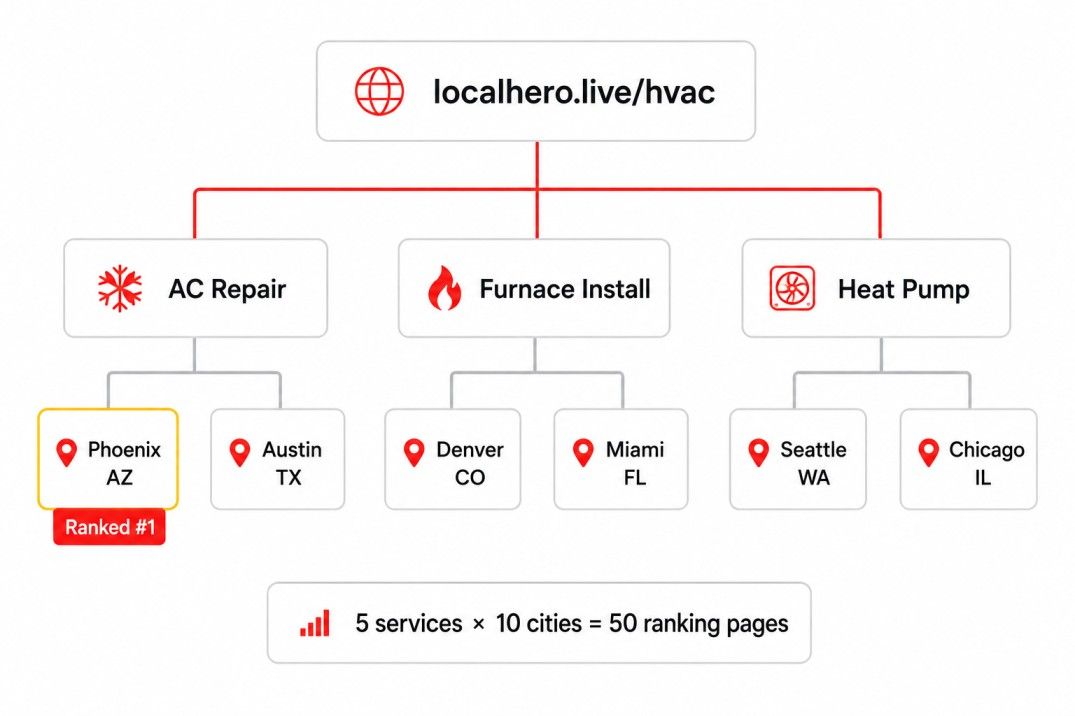
One of the biggest SEO mistakes HVAC companies make is having a single "Services" page with a short list. Google cannot rank one page for "AC repair," "furnace installation," "ductless mini split," and "heat pump service" simultaneously. Each service needs its own dedicated page.
Create Individual Service Pages
Build a separate page for each core service you offer:
- AC repair
- AC installation and replacement
- Furnace repair
- Furnace installation
- Heat pump service
- Duct cleaning
- Indoor air quality
- HVAC maintenance plans
Each page should be at least 600–800 words. It should answer the questions a homeowner actually has: what the service costs, how long it takes, what signs they need it, and why they should call you.
Create Location Pages for Every City You Serve
If you serve multiple cities or neighborhoods, build a dedicated landing page for each one. Not copy-pasted templates with the city name swapped — Google catches that and it backfires.
Each location page needs unique content: references to the local area, specific neighborhoods served, and information relevant to that market. A page for "AC repair in Phoenix, AZ" should talk about desert heat loads and R-410A refrigerant phase-out implications for Arizona homeowners. A page for "Furnace repair in Minneapolis, MN" should reference the 2026 cold season and energy rebates available in Minnesota.
The formula: 5 core services × 10 cities = 50 pages, each targeting a specific query that a real homeowner is searching.
Optimize Every Service Page
Every service page needs:
- H1 tag including the service + your primary city (e.g., "AC Repair in Austin, TX")
- First paragraph that states clearly what you do, who you serve, and what to do next
- A section answering "how much does [service] cost in [city]" — this is one of the highest-traffic HVAC queries
- A list of symptoms/signs the homeowner needs this service
- Your process, step by step
- A clear call to action (phone number + form)
- An embedded Google Map
- Your NAP (name, address, phone) in the footer
Step 3: Get Reviews — Consistently
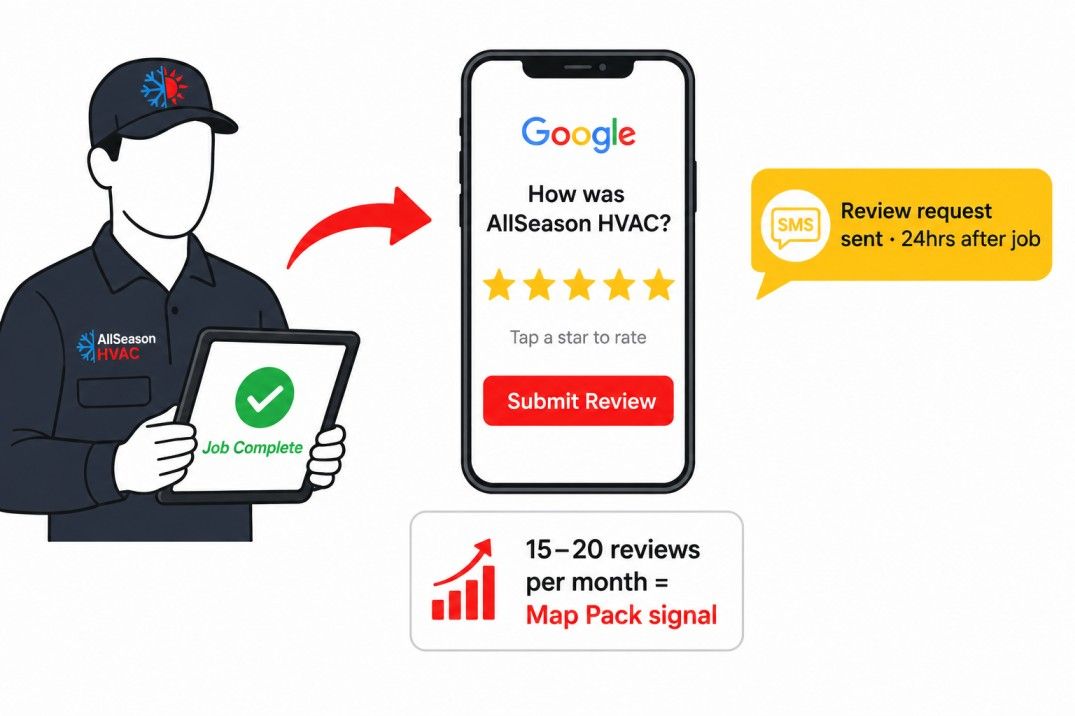
Reviews are the third most important local ranking factor, and they are the most visible trust signal for potential customers. A 4.8-star rating with 200 reviews beats a 5.0 with 12 reviews every time — in both Google's algorithm and in a homeowner's mind.
The Review Timing Problem HVAC Companies Have
Most HVAC companies collect reviews heavily from May through September when emergency calls are constant. Reviews taper off in fall and stop entirely by winter. By February, the profile looks dormant and rankings in the Map Pack fall.
The fix is a year-round system, not a seasonal push.
How to Build a Consistent Review System
Follow these steps to get 15–20 reviews per month regardless of season:
- Send a review request within 24 hours of every service call. Not weekly batches — within 24 hours. Customers remember the job while it's fresh.
- Use both SMS and email. Send a direct link to your Google review page. Make it one tap.
- Train every technician to ask. The ask at the door, right after a clean job, is still the highest-converting approach.
- Work maintenance contract customers year-round. Your recurring clients are your off-season pipeline. You're already in their home in October — ask then.
- Respond to every single review. Positive and negative. Response rate signals engagement to Google. For negative reviews, respond once professionally, take the conversation offline, and move on.
Never incentivize reviews. Offering discounts for reviews violates Google's policies and can lead to your entire review base being stripped.
Step 4: Fix Your Citations
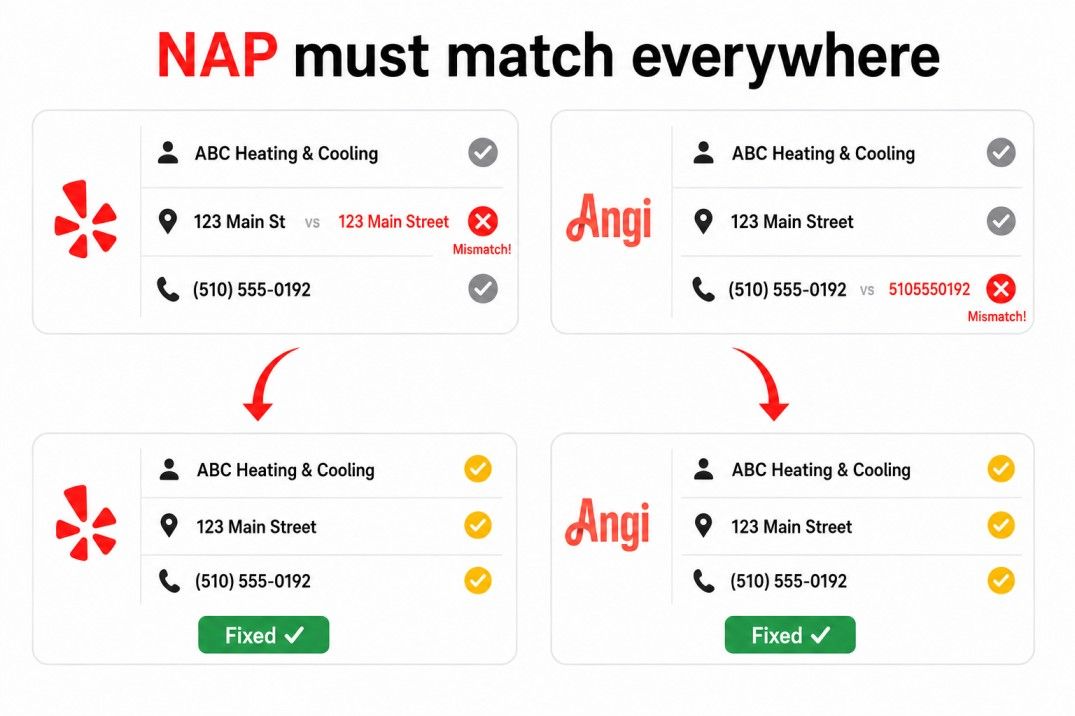
A citation is any online mention of your business name, address, and phone number (NAP). Inconsistent citations are a quiet ranking killer most HVAC companies don't know they have.
If your business name is "AllSeason Heating & Air" in your GBP but "All Season Heating and Air" on Yelp and "AllSeason HVAC" on HomeAdvisor, those inconsistencies confuse Google's verification system. Your local rankings suffer.
Your Core Citation Checklist
Build and verify your presence on these platforms:
- Google Business Profile (primary)
- Apple Business Connect
- Bing Places for Business
- Yelp
- Facebook Business Page
- Better Business Bureau (BBB)
- HomeAdvisor / Angi
- Houzz
- Nextdoor Business
- Thumbtack
- Local Chamber of Commerce directory
The rule for every listing: name, address, phone number, and website URL must be identical across all platforms. That means:
- "Suite 200" not "#200" not "Ste. 200"
- "(512) 555-1234" formatted the same way everywhere
- The same legal business name, no abbreviations or variations
Audit your current listings by Googling your business name + city and checking every result. Fix every inconsistency before moving on.
Step 5: Beat Competitors in the Map Pack
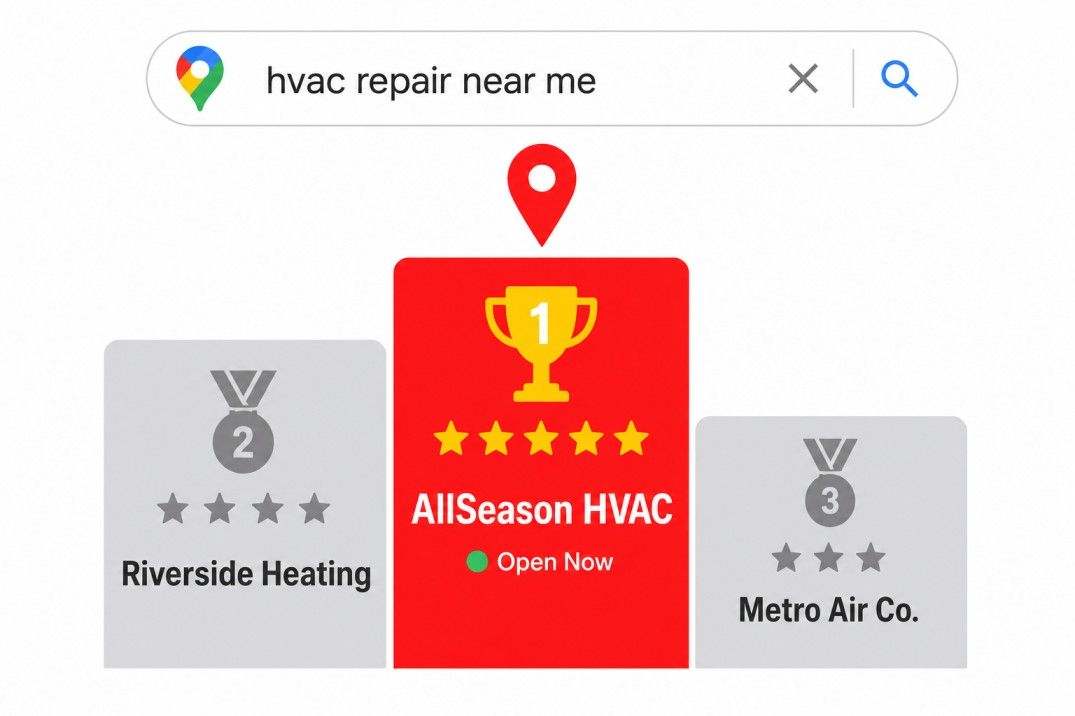
You've optimized your GBP, built your service pages, and started collecting reviews consistently. Now it's time to look at what your top three Map Pack competitors are doing — and do it better.
Run a Competitor Audit
For each of your top three local competitors, check:
- Number of reviews and their velocity — How many reviews do they get per month? What's the average rating?
- GBP completeness — Are they posting weekly? Are photos recent? Is the Q&A section populated?
- Website content — Do they have individual service pages? Location pages? How long are those pages?
- Backlinks — What sites link to them? Ahrefs or Moz can show you this in minutes.
Most HVAC companies in any local market are leaving obvious gaps. Find the gap and close it.
Local Link Building for HVAC Companies
Backlinks from relevant, local websites push your domain authority and local prominence. Here's where to focus:
- Local Chamber of Commerce — Join and get the directory link. Most memberships are $200–$500/year and include a citation and backlink.
- Local real estate and home improvement blogs — Reach out to local home bloggers, neighborhood websites, or HOA publications. Offer to contribute a seasonal HVAC tip article.
- Local news coverage — Issue a press release when you add a new service, hit a milestone, or sponsor a local event.
- Supplier and manufacturer directories — Trane, Carrier, Lennox, and other HVAC manufacturers often have dealer locators that link back to your site.
- Home warranty and home service platforms — Partnerships with home warranty companies can generate both leads and citations.
Content That Captures AI Search in 2026
In 2026, a growing share of HVAC searches go through AI tools like ChatGPT, Perplexity, and Google AI Overviews. These systems look for pages with:
- Clear, direct answers near the top of each section
- Structured headings formatted as questions
- Original information (your own data, real job examples, specific local knowledge)
- A visible, credible author and business
Write your service pages and blog content so that the first paragraph under each heading answers the question completely. Don't bury the answer in the fourth paragraph.
One content angle worth building now: the R-410A refrigerant phase-out. Homeowners are searching for what it means for their existing systems, what new refrigerants (R-32, R-454B) cost, and whether they should replace equipment now. A detailed, city-specific guide on this topic puts you in front of high-intent buyers before competitors react.
Next Steps
You now have the full system. Here's the priority order to implement it:
- Today: Audit your Google Business Profile and fill every empty field
- This week: Set up a review request system — SMS or email within 24 hours of every call
- This month: Build individual service pages for every core service you offer
- Next 90 days: Build location pages for your top 5 service areas, audit and fix all citations, start collecting local backlinks
Local SEO compounds. The HVAC companies that own their local markets in 12 months are the ones starting this work now — not waiting until the slow season.
If you want a professional audit of your current HVAC online presence — what's working, what's hurting your rankings, and exactly what to fix first — get a free SEO audit from LocalHero. We work specifically with home service businesses, and we'll show you where you stand compared to your local competitors.
Want to go deeper? Read our guides on Why Your Google Business Profile Isn't Showing Up, our Google Business Profile Checklist, our Local Link Building guide, and our Local SEO for HVAC service page.
Frequently Asked Questions
How long does local SEO take for an HVAC company?
Most HVAC companies see initial Map Pack movement within 60–90 days of consistent optimization. More competitive keywords like "AC installation [city]" typically take 6–12 months to reach page one. GBP optimization often produces the fastest results — sometimes within 30 days of completing your profile and starting weekly posts.
How many Google reviews does an HVAC company need to rank?
There's no fixed number, but 50+ reviews with a 4.5+ rating puts most HVAC companies in a competitive position in mid-size markets. More important than the total count is review velocity — getting 15–20 per month consistently signals to Google that your business is actively serving customers.
Do I need a separate website page for every city I serve?
Yes, if you genuinely serve those cities. A dedicated page for each service area — with unique content about that city's climate, common HVAC issues, and local service details — helps you rank for "[city] HVAC repair" queries. Copy-pasted templates with only the city name changed will not work and may trigger Google penalties.
Should I run Google Ads instead of investing in local SEO?
Google Ads can generate immediate calls, but the leads stop the moment you stop paying. Local SEO builds an asset that generates calls for free over the long term. Most HVAC companies that grow consistently use both — ads for immediate capacity filling, SEO for the long-term lead machine that reduces reliance on paid spend.
What's the most important thing I can do right now for HVAC local SEO?
Complete your Google Business Profile. Fill every field, add photos, post something this week, and set up an automated review request for every service call. That one combination of actions produces more HVAC ranking movement than almost anything else — and most of your competitors haven't done it properly.
About the author
Ashikur Rohoman
Md Ashikur Rohoman is the founder of LocalHero, a local SEO agency that helps service businesses rank higher on Google and get more calls. He's worked with plumbers, dentists, lawyers, and HVAC companies across the US to build real local visibility through backlinks, citations, and Google Business Profile optimization. Connect with him on LinkedIn
Ready to rank higher on Google Maps?
Get a free audit of your website, Google Business Profile, reviews, and local rankings. No strings attached.
Get my free audit