Local SEO for Plumbers: How to Rank Higher and Fill Your Schedule
Table of Contents
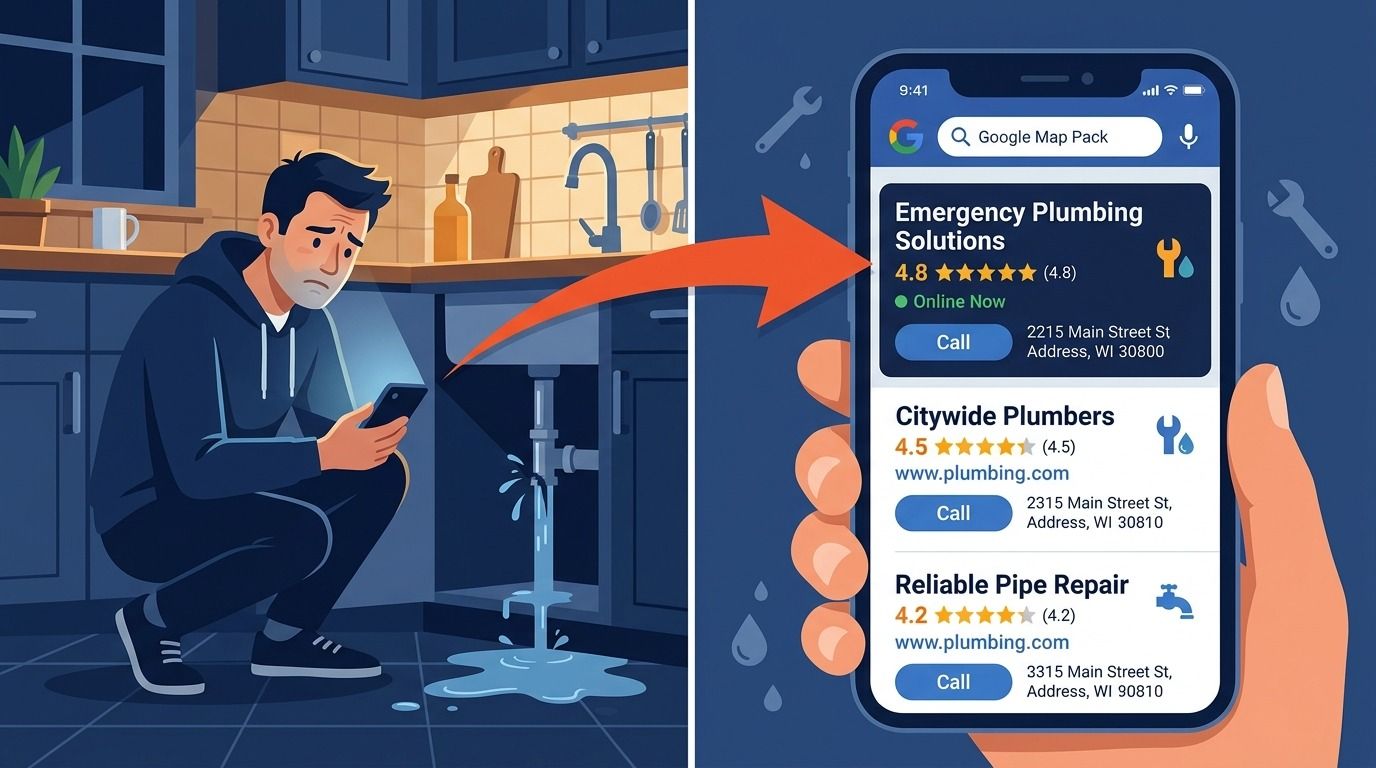
A burst pipe does not wait. Neither does the homeowner searching for help. They grab their phone, type "emergency plumber near me," and call whoever shows up first. If that is not your business, you just lost a job to a competitor — not because they do better work, but because they show up better on Google.
Local SEO for plumbers is the practice of optimizing your Google Business Profile, website, citations, and reviews so your business appears when nearby customers search for plumbing help. Nearly half of all Google searches carry local intent, and most of those searches end in a phone call or a visit within a day. For plumbers, that makes local SEO the difference between a full schedule and a quiet one.
This guide is your complete playbook. It covers every part of local SEO for plumbers — from your Google Business Profile to service area pages to review generation — so you can start ranking higher and filling your calendar with the right jobs.
Why Local SEO for Plumbers Is Different
Local SEO for plumbers is not the same as local SEO for a retail shop or a restaurant. Plumbing searches are driven by urgency. A clogged drain, a flooded basement, or a water heater that quit overnight pushes someone to search and call within minutes, not days.
That urgency changes how Google ranks plumbers and how you need to optimize. Three things make plumbing SEO unique:
-
Emergency intent dominates. Searches like "emergency plumber near me" or "24 hour plumber" need to convert instantly. A slow website or a missing phone number costs you the job.
-
Proximity carries enormous weight. Studies on local ranking factors show that distance from the searcher can account for more than half of local search visibility for service businesses. You cannot change your location, but you can strengthen every other signal to compete with closer competitors.
-
Trust closes the deal. A plumber works inside someone's home. Reviews, licensing, and a complete online profile matter more here than in almost any other local industry.
One plumbing company we reviewed had strong reviews but a bare-bones Google Business Profile and no service area pages. They ranked for their business name but disappeared for "plumber near me" and every neighborhood search around their shop. Building out service area pages and completing their profile moved them into the Map Pack for 14 of their target searches within four months.
For a deeper look at fixing the broader ranking factors behind the Map Pack, see How to Show Up in Google's Map Pack: A Step-by-Step Guide.
How Google Ranks Plumbers in Local Search
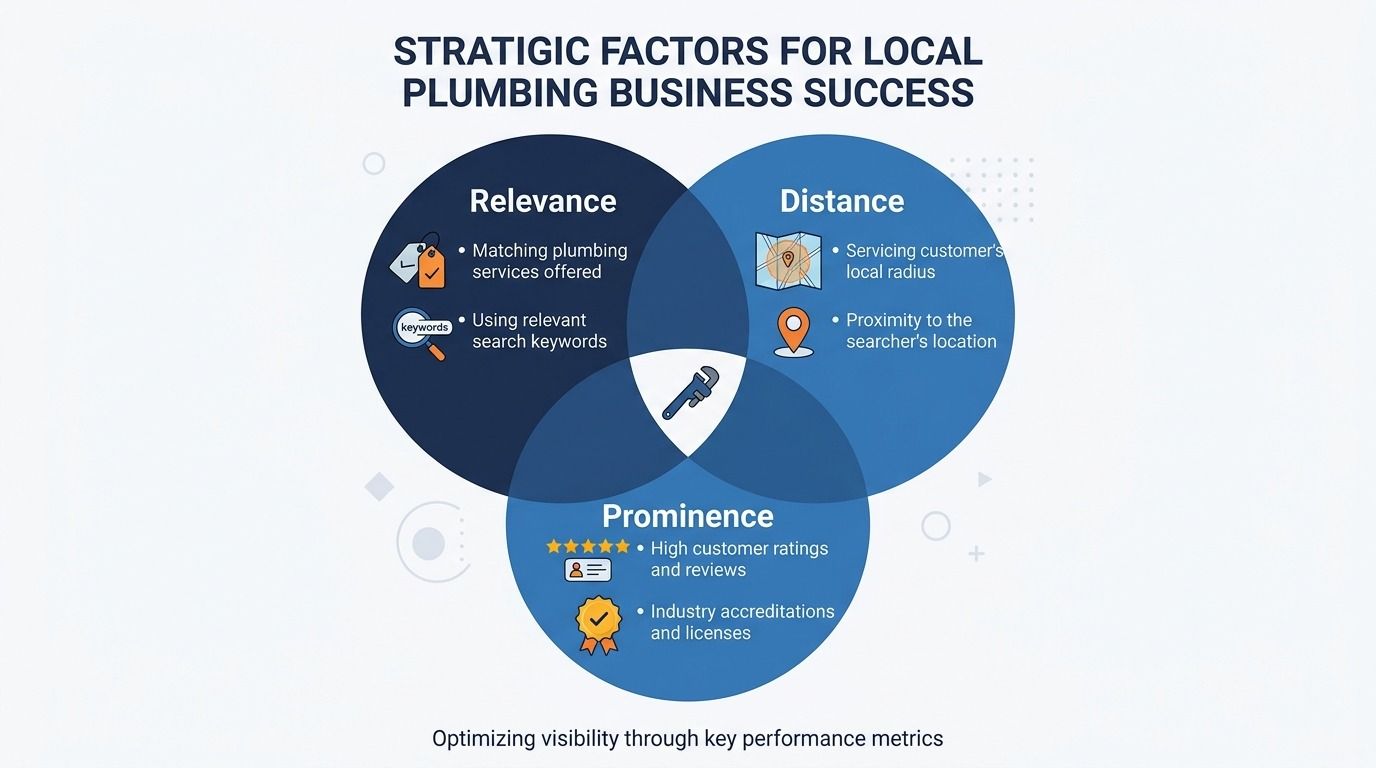
Google uses three core factors to decide which plumbers appear in local search: relevance, distance, and prominence.
|
Ranking factor |
What it means for plumbers |
How to strengthen it |
|---|---|---|
|
Relevance |
Your profile and website match the search |
List exact services: drain cleaning, leak repair, water heater repair |
|
Distance |
How close you are to the searcher |
Build service area pages for every neighborhood you cover |
|
Prominence |
How trusted and well-known you appear online |
Earn reviews, citations, and backlinks consistently |
Relevance means Google can confirm you actually offer what the customer searched for. If someone searches "sewer line repair" and your profile only lists "Plumber" with no specific services, Google has less reason to show you for that search.
Distance is the factor plumbers struggle with most, since you cannot move your shop closer to every customer. The fix is to strengthen the signals you can control — service area pages, location-specific content, and citations that confirm where you operate.
Prominence is where consistent work pays off. Reviews, citations, and backlinks build over time and tell Google your business is established and trustworthy. Of the three factors, prominence is the one where steady effort produces the most reliable, compounding results.
Step 1: Build a Plumber-Optimized Google Business Profile
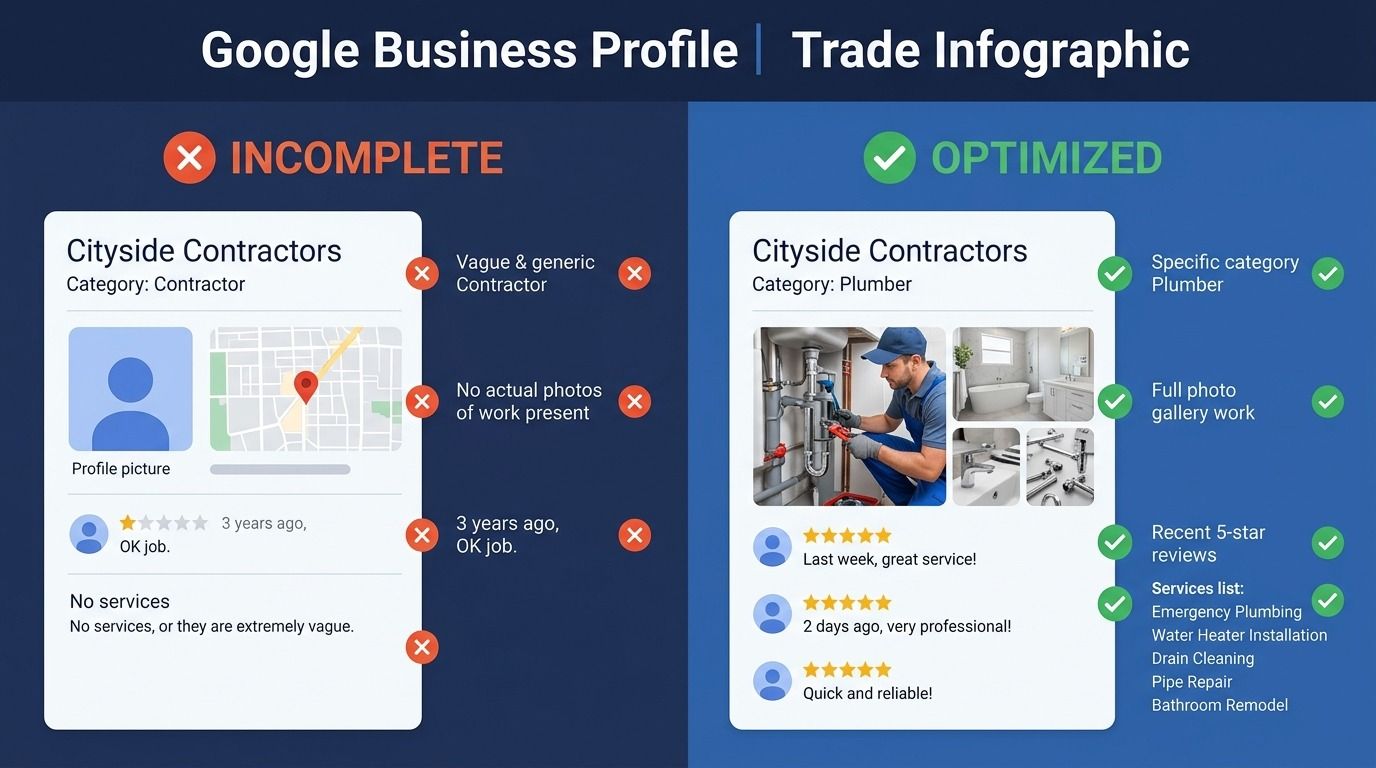
Your Google Business Profile is the single most important asset in your local SEO for plumbers strategy. It is what shows up in the Map Pack, on Google Maps, and in the local results most customers see first.
Here is how to optimize it specifically for a plumbing business:
-
Choose "Plumber" as your primary category. Avoid broader categories like "Contractor" or "Handyman" — they dilute your relevance for plumbing searches.
-
Add every service you offer as a separate listed service. Include drain cleaning, leak detection, water heater repair, sewer line repair, pipe repair, and emergency plumbing. Each one is a chance to match a specific search.
-
Set your service area accurately. List every city, town, or neighborhood you actually serve. Do not list areas you cannot realistically reach — it weakens trust signals over time.
-
Upload real photos weekly. Trucks, completed jobs, your team in uniform, and before-and-after shots build trust and increase engagement.
-
Turn on messaging and Q&A. Plumbing customers often have urgent questions. Answer them quickly to improve your responsiveness score.
-
Post weekly using Google Posts. Plumbing companies that post at least once a week see meaningfully higher engagement and stronger Map Pack visibility than those that post sporadically.
-
Fill out your business description fully. Mention your core services, your service area, and how long you have been in business. Use natural language, not a keyword list.
Pro tip: Proactively answer common questions in your Q&A section, such as "Do you offer 24-hour emergency plumbing?" or "Do you install tankless water heaters?" This captures relevant keywords while answering exactly what customers want to know before they call.
For full setup and ongoing management, see LocalHero's Google Business Profile optimization services.
Step 2: Target the Right Plumbing Keywords
Plumbing customers do not search the way SEO tools assume. They search the way someone under stress searches — short, urgent, and specific to the problem in front of them.
Focus your keyword strategy on two categories:
High-intent service keywords:
-
Emergency plumber [city]
-
24 hour plumber near me
-
Water heater repair [city]
-
Drain cleaning service [neighborhood]
-
Sewer line repair [city]
-
Burst pipe repair near me
Location-modified keywords:
-
Plumber in [neighborhood]
-
[City] plumbing company
-
Best plumber near [landmark or area]
Use Google's Keyword Planner or a tool like Ahrefs or SEMrush to check search volume, but do not over-rely on volume alone. A keyword like "emergency plumber [city]" might show modest volume but converts at a far higher rate than a broad informational term.
Avoid keyword stuffing. Repeating "plumber near me" unnaturally across your site does not improve rankings — it can trigger Google's spam filters and hurt the pages you are trying to rank. Write for the person reading the page first, and let the keyword fit naturally.
Step 3: Build Service Area Pages That Actually Rank
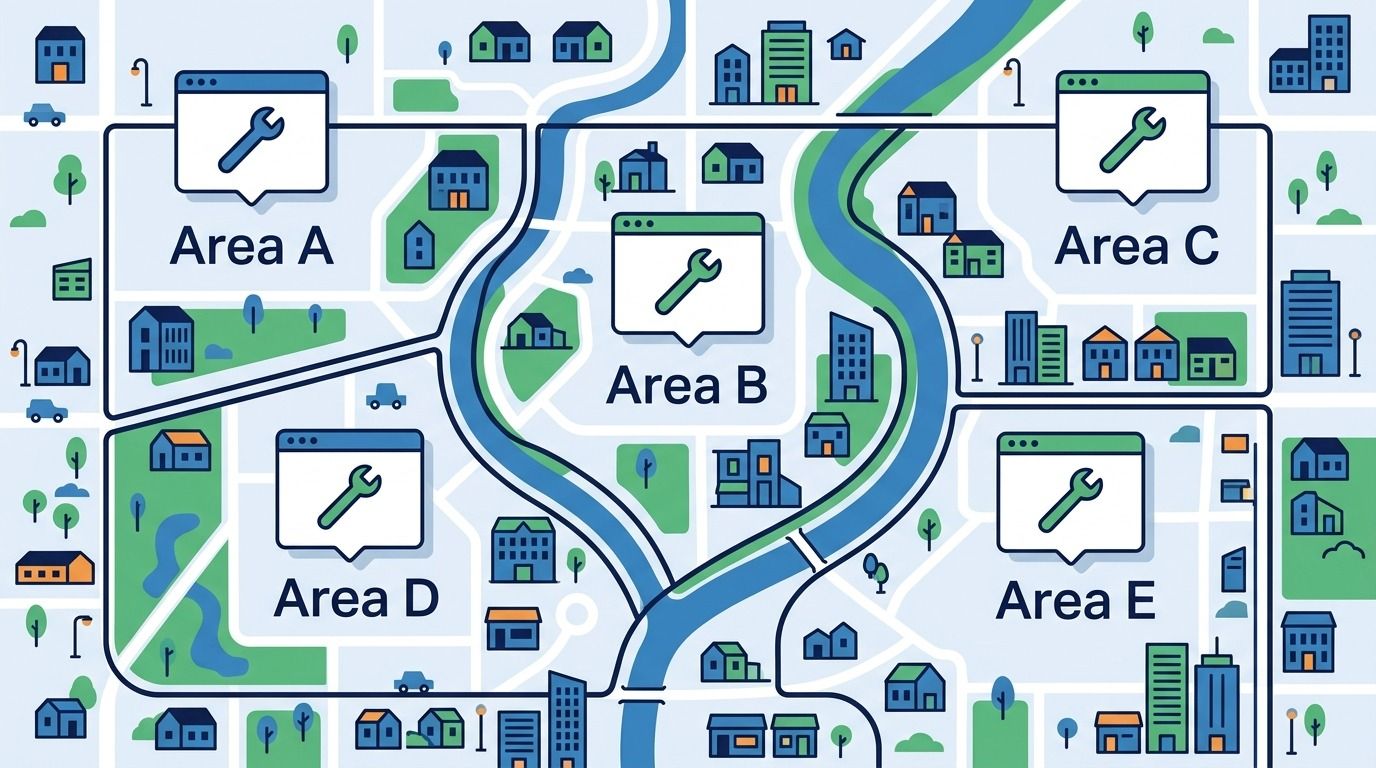
If your plumbing business serves more than one city, town, or distinct neighborhood, you need a dedicated page for each one. A single homepage cannot rank for every location you serve — Google needs a specific page that matches each specific search.
Here is how to build service area pages that actually work:
-
Create one page per service area, not one page that lists every city you serve.
-
Write unique content for each page. Mention local landmarks, common plumbing issues in that area (older homes with galvanized pipes, hard water buildup, frequent tree root intrusions), and the specific services you provide there.
-
Avoid duplicate content across pages. Google penalizes pages that are copy-pasted with only the city name swapped. Each page needs its own voice and local detail.
-
Include your service list and a clear call-to-action on every page — a phone number, a contact form, and a link to request service.
-
Add internal links between your service area pages and your core service pages, such as your water heater repair or drain cleaning pages.
|
Page element |
Why it matters |
|---|---|
|
Unique local content |
Tells Google the page is genuinely relevant to that area |
|
Service list |
Confirms relevance for specific searches |
|
Click-to-call button |
Converts urgent searchers immediately |
|
Internal links |
Connects service area pages to your broader site structure |
|
Schema markup |
Helps Google understand the page's location and service |
For help building and optimizing service area pages at scale, see LocalHero's local SEO services.
Step 4: Get Your On-Page SEO Right
Your website backs up everything your Google Business Profile claims. If your site is slow, hard to navigate, or missing basic SEO elements, it weakens every other part of your strategy.
Focus on these on-page essentials:
-
Title tags with geographic intent. A page should be titled something like "Emergency Plumber in [City] | 24/7 Service," not a generic "Home" or "Services."
-
LocalBusiness schema markup. Add structured data with your business name, address, phone number, service area, and hours so Google can read your details directly.
-
Mobile-first design. Most plumbing searches happen on a phone, often during an active problem. Your site must load fast and display cleanly on mobile.
-
Click-to-call buttons on every page. Do not make a stressed customer hunt for your phone number.
-
Organized service pages. Build dedicated pages for drain cleaning, water heater repair and installation, leak detection, sewer line repair, and hydro jetting. Each page should be easy to find and clearly optimized.
-
Fast page speed. Voice search users and mobile searchers expect instant answers. A slow-loading page loses the customer before they even see your services.
For help with technical and on-page optimization, see LocalHero's site optimization services.
Step 5: Build Citations and Local Backlinks
Citations and backlinks build the prominence signal that strengthens your rankings over time. A citation is any mention of your business name, address, and phone number on another website. A backlink is a link from another site pointing to yours.
Build citations on:
-
Yelp
-
Angi and HomeAdvisor
-
Facebook Business
-
Apple Maps
-
Bing Places
-
Better Business Bureau
-
Local Chamber of Commerce directories
Make sure your business name, address, and phone number match exactly across every listing. Inconsistent information confuses Google and weakens the trust you are trying to build. If your business has moved or changed numbers in the past, audit your citations before building new ones.
Earn backlinks from:
-
Local home improvement blogs
-
Plumbing and trade industry associations
-
Community organizations and sponsorships
-
Local news coverage of community involvement
A single backlink from a trusted local source, such as your city's Chamber of Commerce, carries more weight than dozens of low-quality, unrelated links. Avoid buying backlinks — Google's algorithms detect this and can penalize your site instead of helping it.
LocalHero handles full citation cleanup and backlink building through its citation building and authority backlinks services.
Step 6: Turn Reviews Into a Ranking Engine
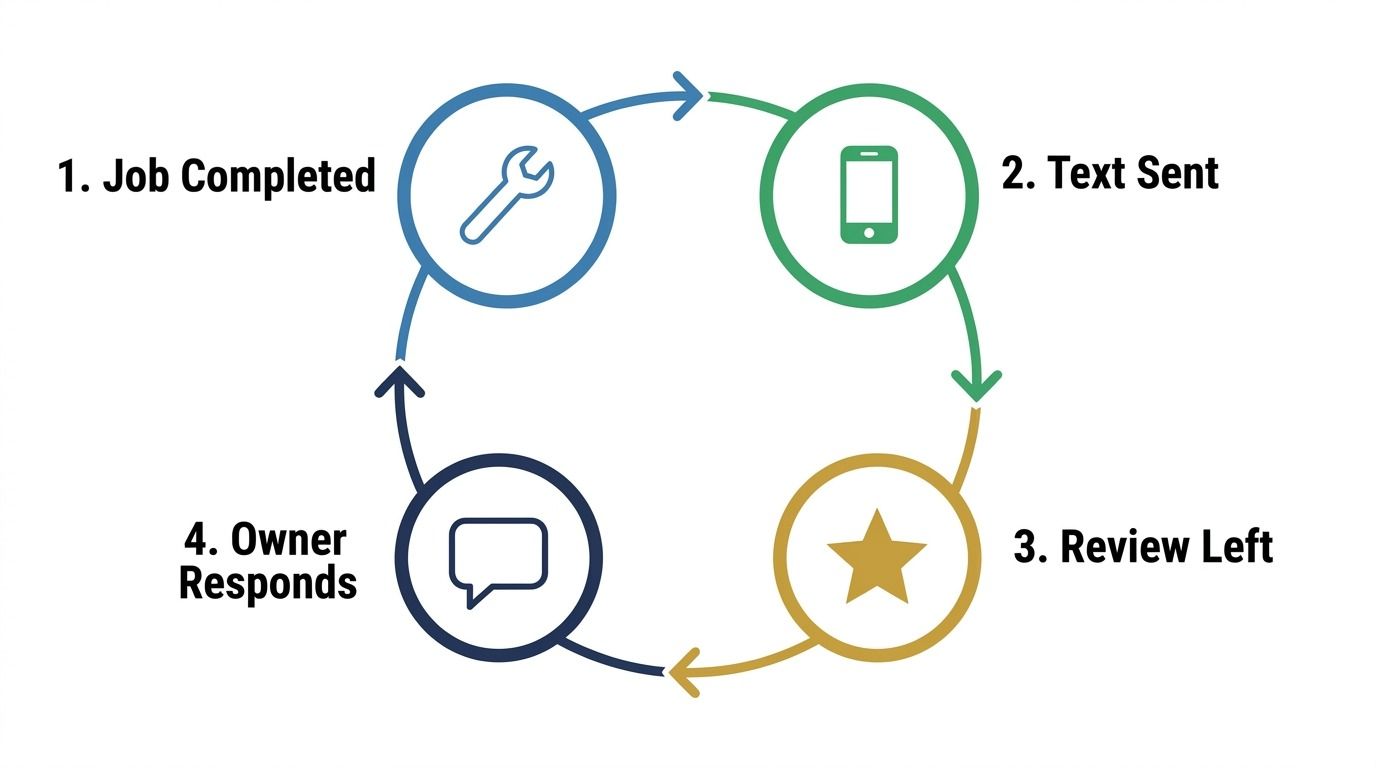
Reviews influence both your rankings and your conversion rate. Customer feedback factors heavily into how Google measures your prominence, and it is often the deciding factor for a homeowner choosing between three similar-looking plumbers in the Map Pack.
Here is how to build a steady review system:
-
Ask immediately after the job is done, when satisfaction is highest. Do not wait until the next billing cycle or follow-up call.
-
Send a direct link by text message. Texting converts better than email for service businesses, since most customers are already on their phone.
-
Aim for a steady weekly flow of new reviews rather than a single large push. Consistency signals an active, trustworthy business to Google.
-
Respond to every review within 24 to 48 hours, including negative ones. A thoughtful response to a bad review often does more for trust than the review itself would have hurt.
-
Never offer incentives for reviews. This violates Google's policies and risks having reviews removed or your profile penalized.
Pro tip: A negative review handled professionally and promptly can build more trust with future customers than having no negative reviews at all. It shows real customers and a business that takes accountability seriously.
For ongoing review generation and response management, see LocalHero's review management services.
Step 7: Use Content to Capture "Near Me" and Voice Searches
Content marketing for plumbers is not about writing generic blog posts. It is about answering the exact questions your customers already ask — before, during, and after they search for help.
Pull your content topics from real sources:
-
Questions asked during service calls
-
Questions left in Google Business Profile reviews
-
Questions submitted through your contact form
Common topics that perform well for plumbers include:
-
Why a toilet keeps running
-
How to tell if a water heater needs replacing
-
What causes recurring drain clogs
-
Signs of a hidden water leak
-
What to do during a plumbing emergency before help arrives
Structure each post to answer the question directly in the first paragraph. This format is what Google pulls into featured snippets and what voice assistants read aloud when someone asks a question out loud. Businesses that publish consistent, helpful content see significantly more organic traffic growth and far more indexed pages than businesses that do not blog at all.
Add FAQ schema to your blog posts and service pages so Google can surface your answers directly in search results.
Step 8: Track What Actually Moves the Needle
Local SEO for plumbers is not a project with an end date. It requires ongoing tracking so you know what is working and what needs attention.
Track these key metrics:
|
Metric |
What it tells you |
|---|---|
|
Map Pack position for target keywords |
Whether you are visible for the searches that matter most |
|
Google Business Profile calls and direction requests |
Whether your profile is converting views into action |
|
Website click-to-call conversions |
Whether your site is doing its job for urgent searchers |
|
New reviews per month |
Whether your review system is consistent |
|
Citation accuracy |
Whether your NAP is still consistent across the web |
Review these numbers monthly. If your Map Pack position drops for a key term, check your citations and reviews first — these are the most common causes of an unexplained ranking slide.
Common Local SEO Mistakes Plumbers Make
Avoid these mistakes, which quietly undo months of SEO progress:
-
Listing a broad category instead of "Plumber." This weakens relevance for every plumbing-specific search.
-
Copying the same content across every service area page. Duplicate content gets filtered out of search results.
-
Ignoring negative reviews. Silence reads as indifference to both Google and future customers.
-
Letting old phone numbers or addresses linger on directories. Inconsistent NAP data confuses Google and weakens your prominence signal.
-
Treating SEO as a one-time setup. Rankings slide without ongoing reviews, content, and citation maintenance.
For a deeper breakdown of fixing inconsistent business information specifically, see How to Fix Wrong Business Information That's Killing Your Rankings.
Checklist: Local SEO for Plumbers
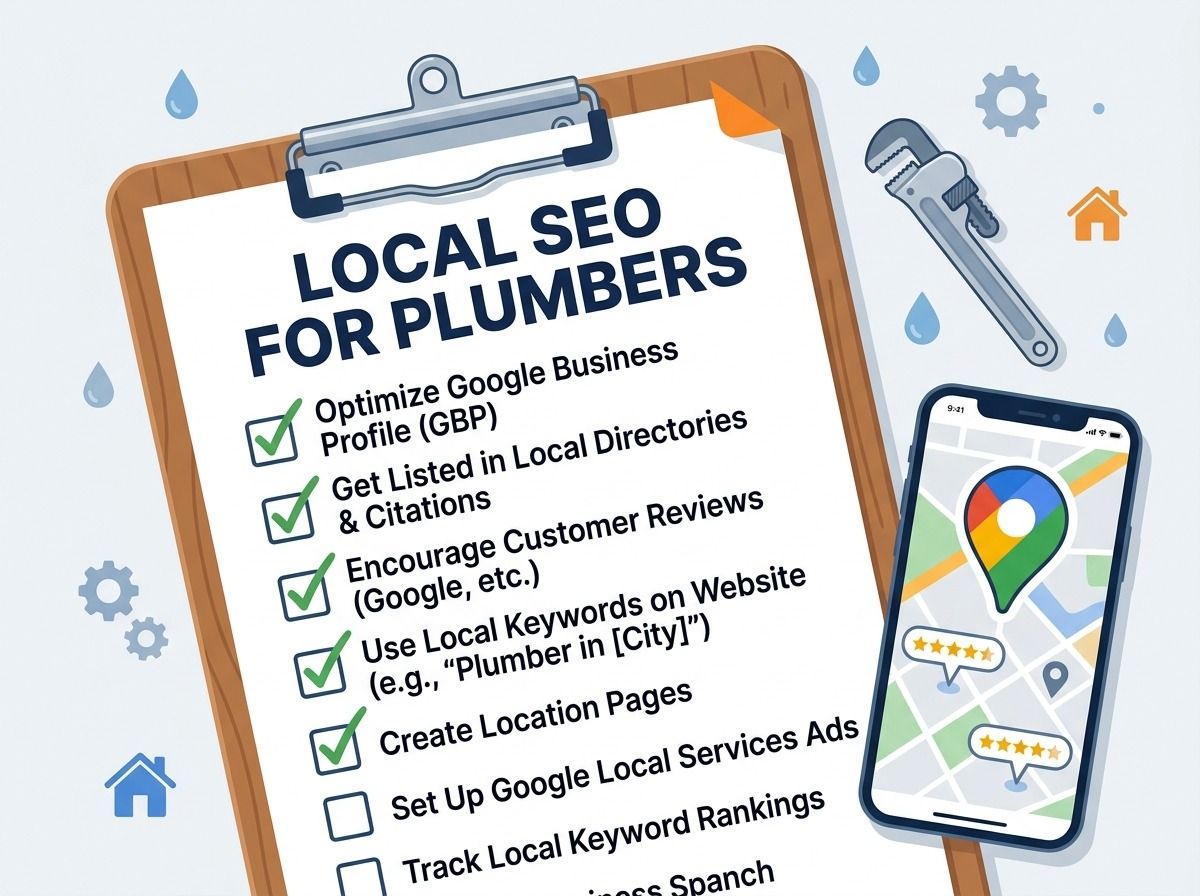
Use this checklist to confirm your local SEO for plumbers strategy covers every major ranking factor.
-
Set "Plumber" as your Google Business Profile primary category.
-
List every individual service you offer on your profile.
-
Set an accurate service area on your Google Business Profile.
-
Upload new photos and post weekly using Google Posts.
-
Build a dedicated service area page for every city or neighborhood you serve.
-
Add LocalBusiness schema to your homepage and service pages.
-
Make sure your site is mobile-friendly with a click-to-call button on every page.
-
Build and correct citations on Yelp, Angi, Facebook, Apple Maps, and Bing Places.
-
Earn backlinks from local organizations, trade associations, and community sites.
-
Set up a weekly review request system and respond to every review within 48 hours.
-
Publish blog content answering real customer questions with FAQ schema.
-
Track your Map Pack position, calls, and reviews every month.
Get a Free Local SEO Audit
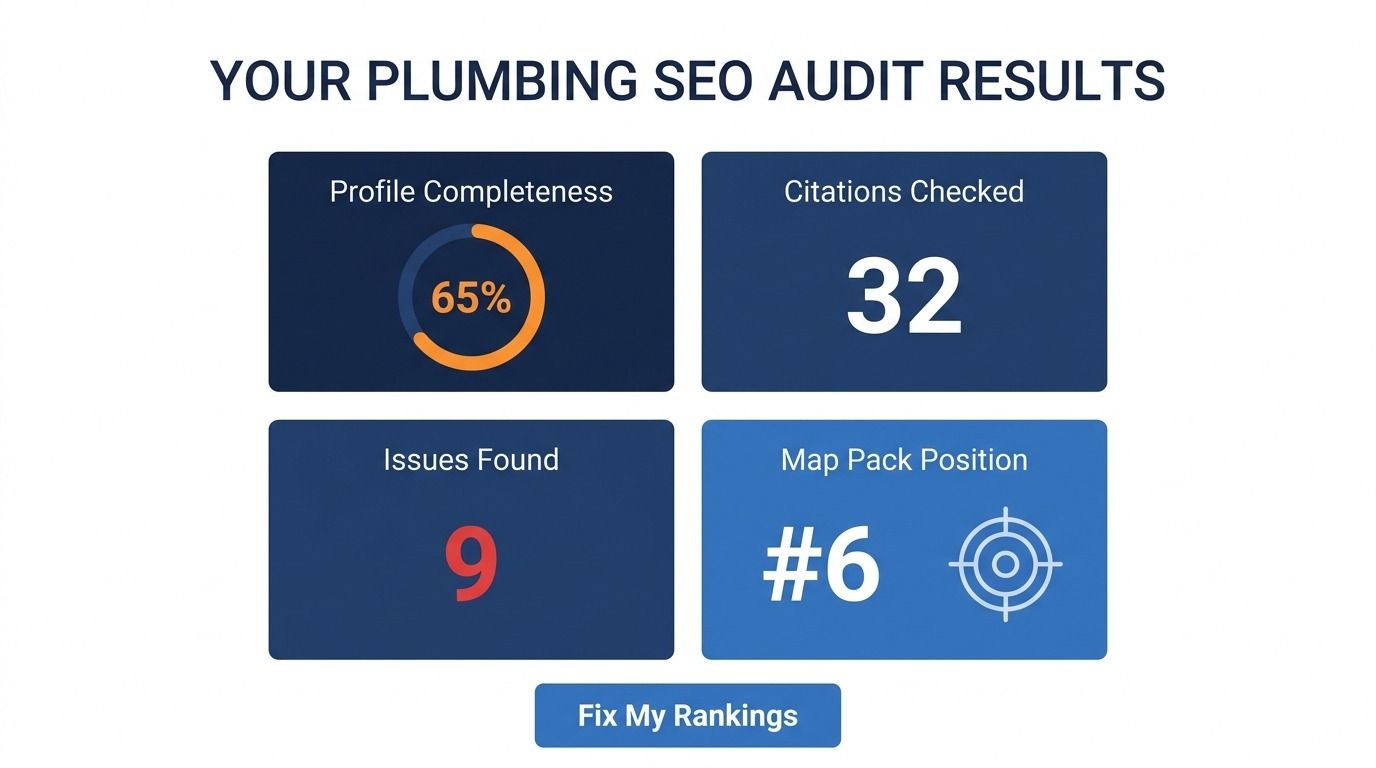
If you are not sure where your local SEO for plumbers strategy is falling short, a full local SEO audit from LocalHero will show you exactly what is holding your rankings back.
LocalHero audits:
-
Google Business Profile completeness and category accuracy
-
Service area page coverage and content quality
-
Website SEO, schema markup, and mobile performance
-
Citation consistency across major directories
-
Review velocity and response rate
-
Backlink profile and local authority signals
Local SEO for plumbers is not one fix. It is a system of profile, website, citation, and review signals working together. LocalHero builds and maintains that system so you can focus on the jobs, not the algorithm.
Get a free LocalHero audit. We will show you exactly what is keeping your schedule from filling up.
Frequently Asked Questions
How long does local SEO for plumbers take to show results?
Most plumbing businesses see initial movement in Google Business Profile visibility within 4 to 8 weeks. Meaningful Map Pack rankings for competitive keywords typically take 3 to 6 months of consistent work. Service area pages and content marketing compound over time, so results tend to keep improving well beyond the first six months as your citations, reviews, and backlinks accumulate.
What is the single most important local SEO factor for plumbers?
Your Google Business Profile is the foundation of local SEO for plumbers. It directly controls your visibility in the Map Pack, Google Maps, and local search results. A complete, accurate, and actively managed profile — with the right category, full service list, and weekly activity — outperforms almost any other single fix you could make.
Do plumbers need a website if they already have a strong Google Business Profile?
Yes. Your website supports and reinforces your Google Business Profile. It is where service area pages live, where customers can read detailed information about your services, and where Google looks to confirm the details on your profile are accurate. Plumbers without a website can still appear in the Map Pack, but they rank lower than competitors with complete, well-optimized sites.
How many reviews does a plumbing business need to rank well?
There is no fixed number, but consistency matters more than total volume. Aim for a steady flow of new reviews every week rather than one large batch. A business with 50 reviews arriving steadily over a year typically outperforms a business with 100 reviews that all came from one promotional push, because Google favors ongoing, recent engagement.
Should plumbers create a separate web page for every city they serve?
Yes, if you genuinely provide service there. Dedicated service area pages help you rank for location-specific searches that a single homepage cannot cover. Each page needs unique, locally relevant content — not a copy-pasted template with the city name swapped — or Google may filter it out as duplicate content.
About the author
Md Shakil Jamal
Md Shakil Jamal is the co-founder of LocalHero and an SEO content strategist. He helps local businesses rank higher on Google, appear in AI search results, and turn online visibility into business growth. Connect with him on LinkedIn.
Ready to rank higher on Google Maps?
Get a free audit of your website, Google Business Profile, reviews, and local rankings. No strings attached.
Get my free audit